In searching for solutions to the crises we face - health, economic, climate breakdown, inequality and racism - we can learn a lot from looking to movements in the US led by working-class communities of colour. On a 14 week tour of North America in 2018, Reel News documented many local struggles against pollution, racism, corruption and the prison industrial complex. These inspiring movements show ordinary people coming together to stand against fossil fuel corporations, to organise mutual aid for recovery after climate disasters, and to move towards a 'just transformation' and a sustainable future.
This video includes 15 minute versions of the American Climate Rebels videos "Hurricane Harvey: Just Recovery in Texas" and "Just Transition in Richmond, California", as well as five inspiring speakers:
Alycia Miles and Ben Hirsch from West Street Recovery, Houston, who helped communities recover and rebuild after Hurricane Harvey - a climate disaster where the official response exacerbated existing racial and wealth inequalities.
Hilton Kelley and Michelle Smith from Community In-Power and Development Association, Port Arthur, Texas - a city where the damaging impacts of the hurricane came on top of exisiting health risks from toxins from oil refineries.
Ratha Lai from Richmond, California, where the local community rebelled against Chevron - the oil company with a political influence over the city which was as toxic as their pollution of the air causing many serious health problems.
You can see all 11 episodes of 'American Climate Rebels' on the Reel News website
Tuesday 9 June, 6.30pm Film screening and speaker discussion
In 2019, £2.1 million of taxpayers' money was paid every single day to Drax power station alone, to burn more wood than the UK produces, emitting more CO2 upfront than burning coal. Two-thirds of this wood comes from from the south-eastern US: clear-cutting diverse forests and replacing these, if at all with monoculture plantations.
Filmed in the US, EU and UK, BURNED takes an unwavering look at the accelerating destruction of forests for fuel. Join us for a discussion about the film with filmmakers Lisa Merton and Chris Hardee, Peter Deane from Biofuelwatch and Sam Mason, PCS union.
The film tells the story of how woody biomass has become the fossil fuel industry's latest attempt to greenwash itself as part of the climate solution, and of the people and parties who are both fighting against and promoting its adoption and use. It also explores how government subsidies are propping up the industry. This destructive industry cannot be part of the low-carbon Just Transformation we need.
Register here for a link to join the Zoom webinar at 6.30pm on Tuesday and (separate link) to view the film beforehand whenever suits you.
Tuesday 9 June, 6.30pm Film screening and speaker discussion
In 2019, £2.1 million of taxpayers' money was paid every single day to Drax power station alone, to burn more wood than the UK produces, emitting more CO2 upfront than burning coal. Two-thirds of this wood comes from from the south-eastern US: clear-cutting diverse forests and replacing these, if at all with monoculture plantations.
Filmed in the US, EU and UK, BURNED takes an unwavering look at the accelerating destruction of forests for fuel. Join us for a discussion about the film with filmmakers Lisa Merton and Chris Hardee, Peter Deane from Biofuelwatch and Sam Mason, PCS Union.
The film tells the story of how woody biomass has become the fossil fuel industry's latest attempt to greenwash itself as part of the climate solution, and of the people and parties who are both fighting against and promoting its adoption and use. It also explores how government subsidies are propping up the industry. This destructive industry cannot be part of the low-carbon Just Transformation we need.
Register here for a link to join the Zoom webinar at 6.30pm on Tuesday and (separate link) to view the film beforehand whenever suits you.
Sharan Burrow, General Secretary of the International Trade Union Confederation (ITUC)
John McDonnell MP, former Shadow Chancellor
Asad Rehman, Executive Director, War on Want
Sean Vernell, UCU Further Education Vice Chair
The coronavirus pandemic is not just a public health crisis but one of inequality. The fatal flaws it reveals in our system are the same ones driving the climate and ecological crisis. During this public health crisis we have seen governments suddenly find the financial and political resources to bail out sectors of the economy - on a scale previously derided as impossible to deal with the climate crisis. The choices made now could push us deeper into crisis, worsening inequality globally, creating huge job losses and worsening the climate and ecological crisis through bailing out climate polluters in aviation and fossil fuel industries. Or we could seize this opportunity. In this webinar our speakers will discuss how we can mobilise for a just transformation of society, which has never been more urgent.
Below, a video message from Vanessa Nakate, Ugandan climate strike activist:
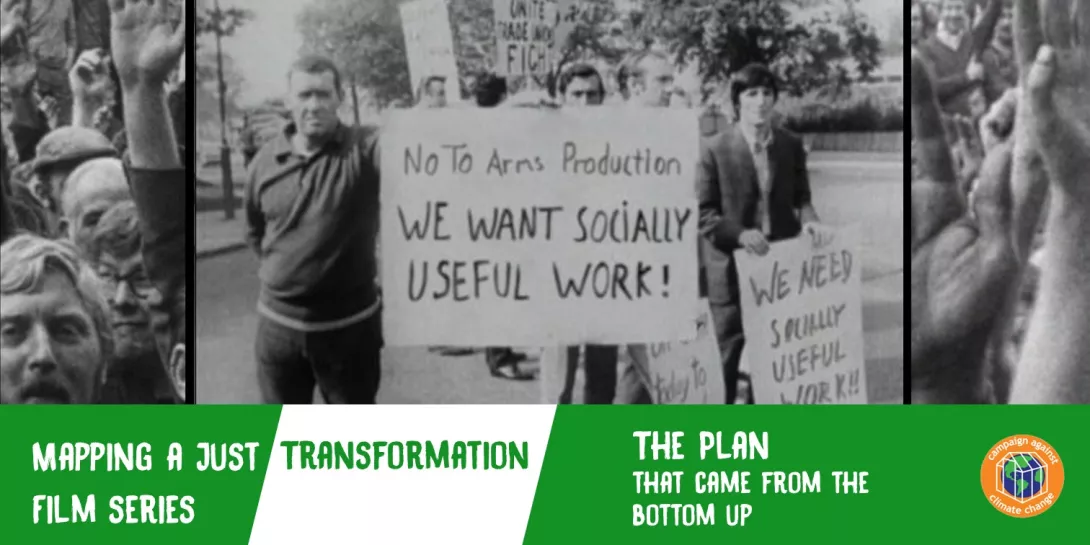
Hosted by Campaign against Climate Change trade union group, a series of film screenings will explore the need for radical transformation in society, as exposed by the COVID-19 pandemic, and the climate and ecological crisis which has not gone away. The film showings and discussion will be an opportunity to map what this Just Transformation could look like. We start with The Plan, taking inspiration for today's Just Transformation from visionary manufacturing workers and trade unionists from the 1970s.
‘THE PLAN that came from the bottom up’ is a thought-provoking film on the extraordinary story of Lucas Aerospace engineers. Forty years ago they responded to the threat of redundancy with their own plan of action, developing alternatives to the military products their company made, including wind turbines and hybrid cars.
There will be a Q&A with speakers Steve Sprung, the film’s director, and Danielle Paffard from Green New Deal UK, talking about the forthcoming national Build Back Better campaign.
Discussion will start at 6.30pm, and we'll provide links for you to view the film (either the half hour version or the longer version) before. Register here and we'll email you details for how to join.
Please join us for this discussion when the need for a Just Transformation has never been so urgent.
More frequent, intense and unpredictable weather events, such as floods, storms, hurricanes and typhoons have wreaked terrible devastation across the world in recent years. Other natural hazards such as drought and wildfires are causing environmental degradation and change, and helping to drive migration globally.
Last year 23 million people were forced to move due to climate and weather-related disasters: one person every second! The people hit first are the poorest from those countries that have contributed the least to global warming, and have the least resources to protect themselves from the problem.
Date/time: Saturday 14th March, arrive from 12.30 for a prompt 1pm start to the main meeting.
Venue: Mill Hill Unitarian Chapel, City Square, Leeds LS1 5EB. This is almost directly opposite Leeds railway station, on the right hand side of City Square as you look upwards away from the station (see https://www.millhillchapel.org/). We will be in the area called the Priestley Room, which is separate from the chapel area and entered by the door at the bottom end of the building (up steps or a ramp).
We strongly recommend not to travel by car unless absolutely necessary, and let us know in advance if you will need a disabled parking space.