Steve Wright, General Secretary, FBU Liz Wheatley, UNISON NEC Asad Rehman, Chief Executive, Friends of the Earth Chair: Suzanne Jeffery, CACCTU
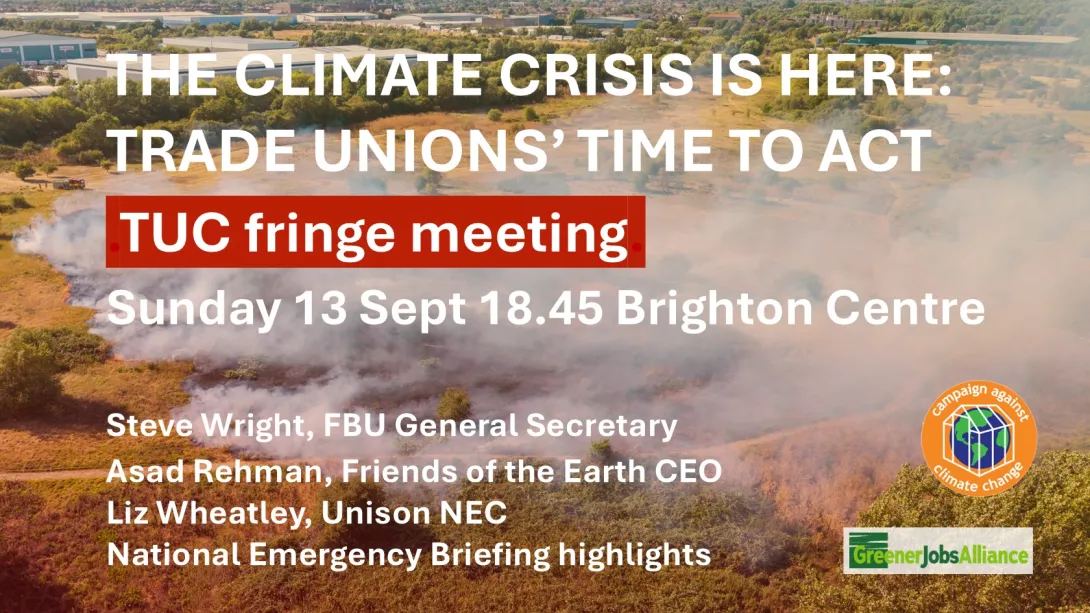
In the trade union year of climate action, after a summer of heatwaves, drought and wildfires, the reality of the climate crisis is upon us. Join us at our TUC fringe meeting to hear from trade unionists whose members are on the front line dealing with the impacts of climate breakdown.
To help understand the context of what we are facing, we'll show a short film with brief highlights from climate experts at the National Emergency Briefing.
Then discussion will focus on how trade unions can lead the way in demanding action which meets the true scale of the crisis and centres the needs of workers and communities. This means delivering decent unionised jobs, comfortable and affordable low carbon homes, high quality public transport and better health.
This meeting is in the Brighton Centre as an official TUC fringe, so open to TUC delegates only
Start time: 18.45 (or after TUC formal business ends) Meeting Room 1D
Thanks to PCS Union for their contribution to funding the event.
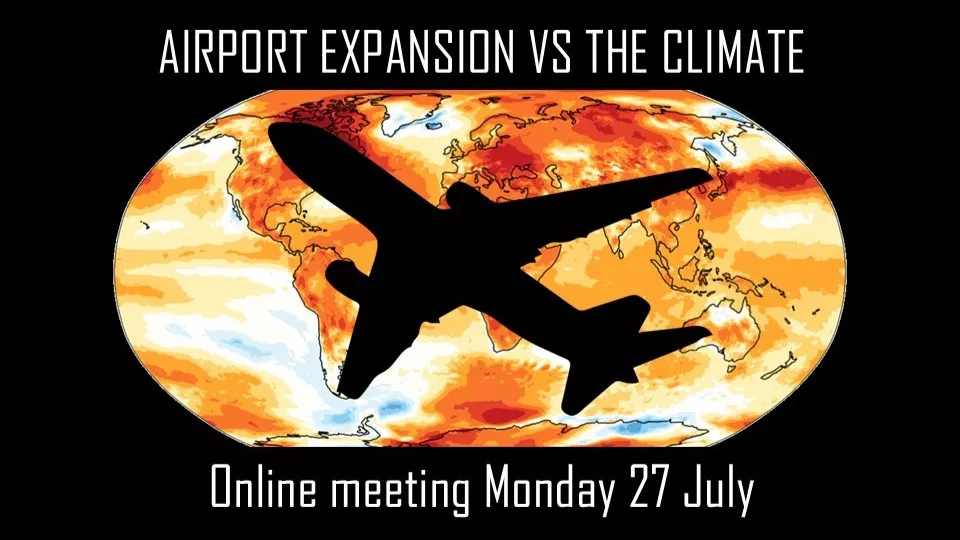
On Thursday 18th June, under cover of the Makerfield by-election, the government quietly released its public consultation for the Heathrow Expansion National Policy Statement. It's hard to grasp the scale of what is planned - the equivalent of building another Gatwick airport next to Heathrow, and requiring the M25 to be rerouted. Despite this, the brief consultation will only run until 1st September, while MPs and the public are off on their summer holidays.
As a relentless series of heatwaves sweep across Europe, will new Prime Minister Andy Burnham keep up the pretence that reckless aviation expansion is compatible with UK climate policy? Will he take on board the evidence that the much-touted economic benefit of Heathrow expansion is smoke and mirrors? Or review the government's 'Jet Zero' greenwash policy which has allowed expansion of airports around the country, ignoring their cumulative impact?
Join our meeting to find out the true facts about airport expansion, and what we as climate campaigners can do.
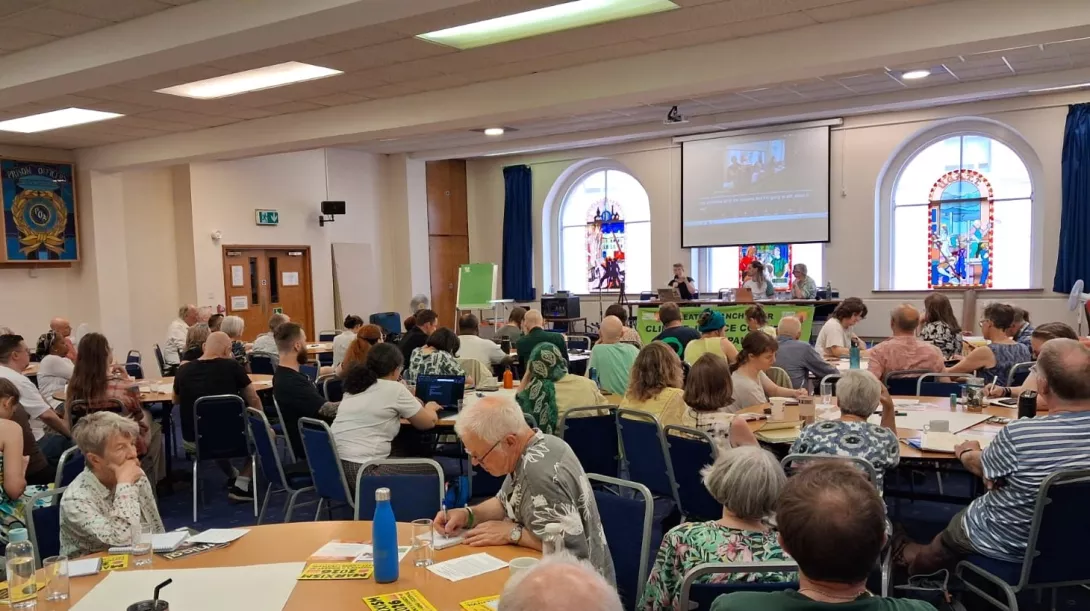
This conference was a great opportunity to discuss the many issues around AI and data centres and the ways in which trade unions and campaigners are working to protect people and the environment. You can read a report from the day below, and also watch the video of speakers. The full transcript is here, and slides linked below.
UPDATE: Since the conference, Microsoft released emissions data showing an increase of 25% in the past year alone, matching Google's increase of 25% and Amazon 16%, all leaving previous climate pledges stranded in the dust.
Session 1: The uses of AI in war and surveillance
Speakers: Anne Alexander, a researcher and journalist covering the social, ecological and political impacts of AI systems, currently working on a forthcoming book on the AI Arms Race; Rory Gibson, Medact, No Palantir in the NHS
Let's reclaim Earth Day from greenwash! In 1970 the first Earth Day took place with an estimated 20 million Americans participating in rallies, marches, and teach-ins responding to toxic pollution of their air, waters and land by corporations pursuing profit in the absence of environmental regulation. Then, as now, the worst exposed to these hazards were working class and non-white Americans. The largest source of funding for the first Earth Day was organised labour, in particular from the United Auto Workers (UAW) which also provided practical support for printing and telephone communications. The national organiser for Earth Day later said "Without the UAW, the first Earth Day would have likely flopped."
On Saturday 28th March an estimated half a million people marched through central London in response to the far right threat to communities, responding with hope, not despair, and unity, not division and standing for a country where everyone belongs. Photos below from the lively climate bloc.
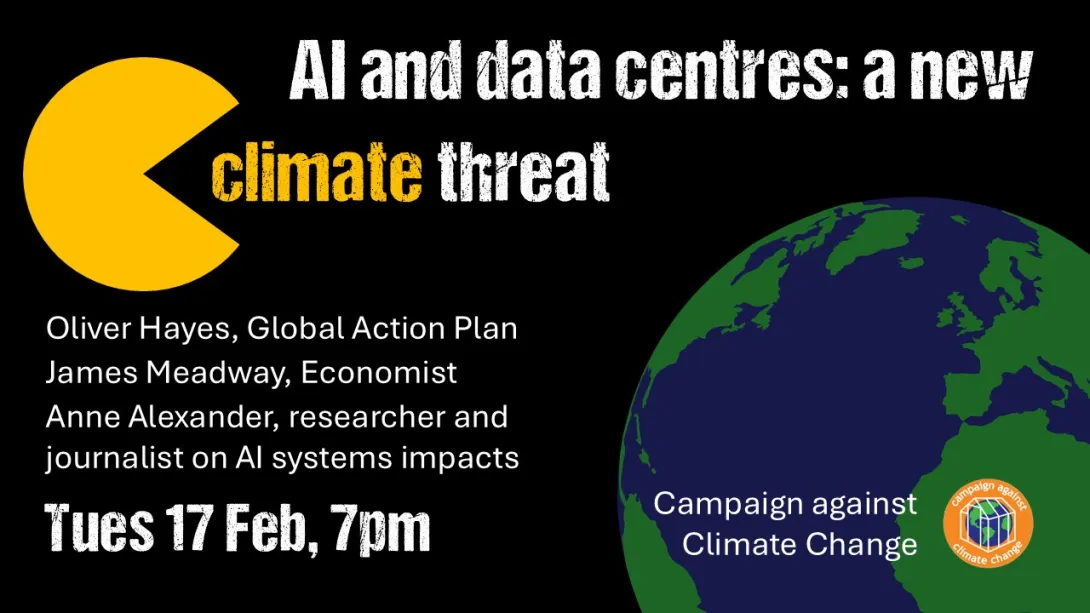
The explosion of generative AI has caused a global boom in the construction of energy-hungry data centres with associated fossil fuel power expansion, as well as concerns about the strain they may place on clean energy resources, grid capacity and water use.
With the UK government keen to fast-track data centres, over 50 are currently being planned or built in the UK, including the largest ever built here, in Cambois, Northumberland. What can we do as campaigners to minimise the climate and environmental impact? And how does it link to social concerns?
Join us for this webinar to hear from experts in this complex area.
Oliver Hayes is Head of Policy & Campaigns at Global Action Plan, which recently won a legal case against the government approving a hyperscale data centre in Buckinghamshire without properly considering the energy use and environmental impact.
Anne Alexander is a researcher and journalist covering the social, ecological and political impacts of AI systems, currently working on a forthcoming book on the AI Arms Race
James Meadway is an economist, host of the weekly economics podcast, Macrodose.
The week of 9-15 February is the annual 'Heart Unions' week, when trade unions spread the word about why unions are important to everyone at work and reach out to encourage new members to join. Trade unions are built on a universal principle - that we are stronger together. Many of the rights we enjoy at work today were won because workers came together in trade unions and fought for them.
Today the climate crisis is the biggest struggle facing us demanding collective action. We need solutions that centre social justice, the needs of communities and workers and international solidarity.
Trade unions are already acting on climate change. However, as with any other part of society, the urgency of the climate crisis means we need to push for faster action. By joining a union, you can help support existing networks that take action, raise awareness, and make links between the climate crisis and other important issues.
Practical things to know:
Your employer might already recognise a specific union. If there is an active union at work, you can find out who your representatives are and speak to one of them. Collective action means that unionised workplaces have better pay and benefits (getting paid around 6.5% more than workers in similar non-unionised workplaces). Union reps can also negotiate on important issues like health and safety.
Following the COP30 UN climate conference, in the year of trade union climate action backed by the TUC and UK unions, we – trade union leaders, reps and activists – call on the Labour government to refuse approval for the climate-wrecking Rosebank oil field.
With the climate crisis already bringing record heat, wildfires, flooding and drought in the UK and far beyond, Labour must not cave in to the profit-seeking of polluters and the anti-science, pro-fossil fuel agenda of Donald Trump and Nigel Farage.
A rapid, just global transition from fossil fuels is needed to avoid a catastrophic climate breakdown, as advocated in policy passed by TUC Congress. Approving a huge new oil field, producing more CO2 than the world’s 28 poorest countries do in a year, is not compatible with that goal.
Rosebank would violate the UK’s international climate commitments. The scientific evidence shows there is no room for new North Sea oil and gas projects if we are to stay within thresholds set out in the Paris Agreement.
This oil field – most of which is oil destined for export – would do nothing to lower bills or boost energy security. Thanks to the enormous tax breaks for new drilling in the UK, approving it could actually lead to a net loss to the Treasury of over £250 million, while the field’s owners Equinor and Ithaca pocket up to £1.5bn in profit.
A meeting hosted by Campaign against Climate Change trade union group ahead of COP30, to hear from speakers from around the world about the impacts of the climate crisis and how the solutions lie in international solidarity.
Speakers:
Sabrina Fernandes, Brazilian political economist and ecosocialist, currently the Head of Research at the Alameda Institute, and an expert on just transitions, Latin America, and internationalism, warning of how the solutions to the climate crisis cannot be found in green capitalism and exploitation.
Suraya Jawoodeen, Africa Coordinator, Trade Unions for Energy Democracy, a global network working to advance democratic control and social ownership of energy
R D Chandra Shekar, General Secretary of Andhra Pradesh and Telangana INTUC and Andhra Pradesh Agriculture Workers Trade Union Congress, on how Indian trade unions are responding to attacks on workers rights and the challenges brought by climate breakdown.
Leon Sealey-Huggins, Senior Campaigner on Just Transition, War on Want, on the campaign ahead of COP30 for a Belém Action Mechanism to bring about fair, rights-based global climate action through the Just Transition Work Programme.
Dr Sifiso Ndlovu, Zimbabwe Teachers Association
Chair: Sarah Woolley, General Secretary, Bakers, Food and Allied Workers Union
As the UK experiences multiple heatwaves, we all know that there's a big difference between high temperatures sitting in the shade on holiday and the same temperatures in workplaces which aren't designed to cope. There is still no maximum working temperature in the UK, just a minimum working temperature
Heat Strike is a campaign pushing for protections for workers during extreme heat. The campaign is calling for things like a maximum working temperature, heatwave furlough schemes, and proper climate mitigation plans. You can sign up for updates.
One of the key actions is encouraging union members to do lunchtime or after-work banner moments – standing outside your workplace with signs like 'Heat Strike' or 'Too Hot to Work' to highlight how unsafe it can be to work in these conditions. They can be downloaded here - or homemade is fine. Another idea is to take thermometers into work for a visual record of the temperature.
Post photos with the hashtags #HeatStrike #TooHotToWork