Despite being faced with many immediate battles to fight, it is to the credit of many trade unions that they are also addressing the long term wellbeing of their members, and of future generations, by introducing policies to tackle climate change. A new report providing the first ever overview of the climate change policies of 17 major UK trade unions could help raise wider awareness of this important work.
The author, Catherine Hookes, is studying for a masters degree at Lund University, Sweden, and her research drew on a comprehensive web review of policies in these unions, going into more depth for many of the unions, interviewing key figures and activists. The research was facilitated by the Campaign against Climate Change.
For anyone within the trade union movement concerned about climate change (or for campaigners wishing to engage with trade unions on these issues) this report is of practical use in understanding the context, the diversity of different trade unions' approaches, and the progress that has been made in the campaign for a just transition to a low carbon economy.
From Reclaim the Power's "Rolling Resistance Weekly Round-Up: Week 2" (link here):
Image
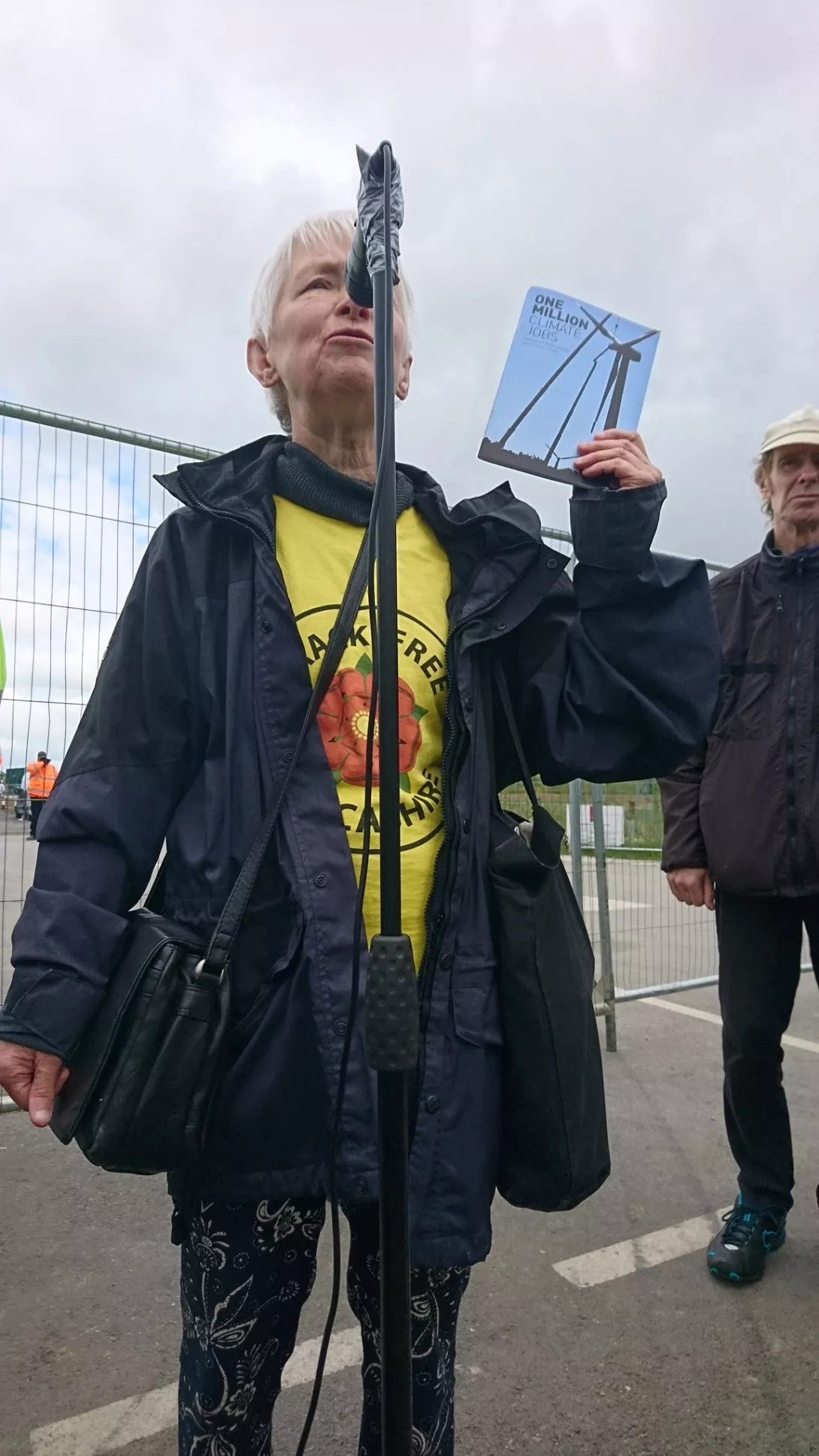
"A mass demo for climate, jobs, renewables and divestment! The day started with a two car lock on, which kept the gates shut until the crowds arrived. An estimated 200 people came down to the roadside today – many for the first time. We celebrated the resistance so far and heard from a range of speakers about the solutions we need to see and the wider politics of climate justice, and economic and social justice – of which the anti-fracking movement is part."
"Many trade unions were represented including PCS, Unite, Unison, the NUT and UCU and their speakers emphasised how the Trade Unions would keep supporting the fight against fracking. Strength in numbers meant our mere presence shut Cuadrilla’s site down for the day. It felt like a carnival, with singing, delicious food and even some disco yoga and this very positive and powerful day ended with people linking arms in front of the gate."
The trade union UNISON has unanimously voted to pass a motion to divest council pension funds from oil, coal and gas. UNISON is one of the two biggest trade union groups in the UK, with over 1.3 million members, and is also the primary representative for local government workers, whose pension funds are collectively worth over £200 billion.
Update: following clarification from fracking campaigners we understand that the manifesto pledge poses a greater threat than is immediately apparent - this blog post has been updated accordingly.
Fracking
The doors may have opened a chink for onshore wind in the manifesto (see below), but they are thrown open for fracking. "Non-fracking wells" would become permitted development, so would not need planning permission. The Infrastructure Act redefined the term 'fracking' to reduce the activity in the UK that would be covered by it. All oil drilling in the Weald in the south east and much of the initial testing for shale gas elsewhere will not need planning permission.
‘Climate Refugees’- The Climate Crisis and Population Displacement: Building a Trade Union and Civil Society Response - 11 February
A woman wading through flood waters is replacing the polar bear as the defining image of climate change. Delegates to the UK’s first trade union and Friends of the Earth conference on Climate Refugees (Saturday 11 February) learned that in the past six years over 140 million people have been displaced through climate-related disasters – one person every second.
The risks will redouble in coming decades, reversing years of development activity in the global South. In a keynote speech, Asad Rehman (FoE) said that to achieve our goal of UN action to address the climate migration crisis means creating a new narrative which draws wide support across civil society and is based on the principles of ‘justice, empathy and humanity.’
Briefing delegates on the hard evidence of climate change, Prof Joanna Haigh (Grantham Institute) said that every indicator was flashing: rising sea levels, warming oceans and shrinking Arctic sea ice. ‘Globally warming is not globally uniform,’ with the greatest increases in polar regions and across sub-Saharan Africa. The current growth in carbon emissions would place as much as a quarter of the world’s population exposed to water scarcity, flooding impacts and crop failures.
For Unite the Union, Diana Holland was ‘angry and ashamed’ at the government’s inhumane treatment of child migrants. Trade unions have shown through campaigns such as Chile Solidarity and organising migrant domestic workers what international solidarity can deliver. Where union members are impacted by climate change, our demand must be for a Just Transition, with everyone at the table.
Reinforcing this message, Chidi K
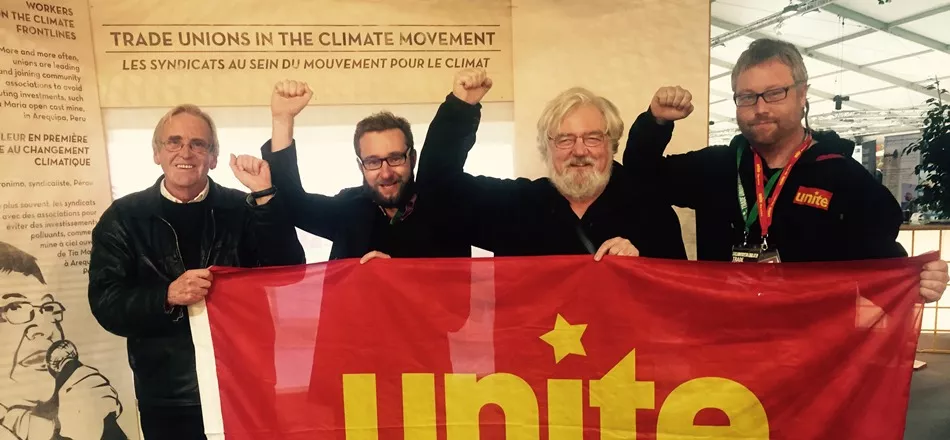
Image
ing (first right, see left) said that the ITUC (International Trade Union Confederation) was developing a Just Transition programme to engage trade unions, governments and communities in demands for investments in low carbon technologies, green jobs and new skills. Climate change would drive up global poverty: so zero poverty and zero carbon were two core issues for the ITUC.
Zita Holbourne (second right), PCS Vice-President, argued that it was impossible to separate climate change impacts from other causes of human displacement, including war, fear of persecution, famine and poverty. For many climate refugees, their ordeal is not over when they arrive in the UK, where they are often treated as third class citizens. Unless we are to pass to our children a world worse than ours, we need a new vision for race equality in 2025, based on social justice and equity.
Saturday’s workshops covered the planetary emergency, building trade union solidarity, challenging racism and xenophobia, the Moving Storiesof climate migrants, and creating a new narrative around climate refugees. Also, the Environmental Justice Foundation presented its excellent short film, Falling through the Cracks.
We are deeply saddened at the death of our friend and great climate campaigner and socialist, Ken Montague, who passed away last Friday.
Below are tributes from Suzanne Jeffery and Jonathan Neale.
Ken was secretary of the Campaign against Climate Change trade union group and a member of CACC steering group for many years. During that time Ken played an invaluable role in developing the work of the trade union group and especially the One Million Climate jobs report and campaign.
Ken's work was unseen and often unsung but without it much of what the CACC trade union group have done in the last few years would not have happened. Ken's work allowed the trade union group to campaign increasingly effectively within the wider trade union movement, to develop a deeper understanding of the climate crisis, its relevance to the struggle of working people and to counter the false narrative that jobs and the environment are mutually exclusive.
The charges for contempt of court have been dropped in a major victory for the anti-fracking movement and the right to peaceful protest
---
Tina Rothery, Lancashire Nana and anti-fracking campaigner, is being aggressively pursued for legal costs of over £55,000 and the likelihood of a possible two-week prison sentence, thanks to the actions of fracking company, Cuadrilla. Her supporters, including well-known figures such as Emma Thompson, Vivienne Westwood and trade union leaders, as well as NGOs and campaign groups, have today called on Francis Egan, CEO of Cuadrilla, to drop the case as completely unjustified. Hundreds are expected to gather outside Preston court on Friday when her case is heard, under the banner #IamTinaToo.
Paul Ridge of Bindmans solicitors said: “I have never seen a company behave as aggressively and for such a sustained period towards a single protestor on the matter of costs as in this case by Cuadrilla.”
The charges for contempt of court have been dropped in a major victory for the anti-fracking movement and the right to peaceful protest
---
Tina Rothery, Lancashire Nana and anti-fracking campaigner, is being aggressively pursued for legal costs of over £55,000 and the likelihood of a possible two-week prison sentence, thanks to the actions of fracking company, Cuadrilla. Her supporters, including well-known figures such as Emma Thompson, Vivienne Westwood and trade union leaders, as well as NGOs and campaign groups, have today called on Francis Egan, CEO of Cuadrilla, to drop the case as completely unjustified. Hundreds are expected to gather outside Preston court on Friday when her case is heard, under the banner #IamTinaToo.
Paul Ridge of Bindmans solicitors said: “I have never seen a company behave as aggressively and for such a sustained period towards a single protestor on the matter of costs as in this case by Cuadrilla.”
This is what it looks like on the front line of the fossil fuel industry in 2016. As water protectors at Standing Rock attempted to remove burned-out trucks that had been blocking the bridge, police attacked them with tear gas, concussion grenades, rubber bullets and water cannon in subzero temperatures, seriously injuring many. Reports suggest 300 people were injured and 27 needed hospital treatment.
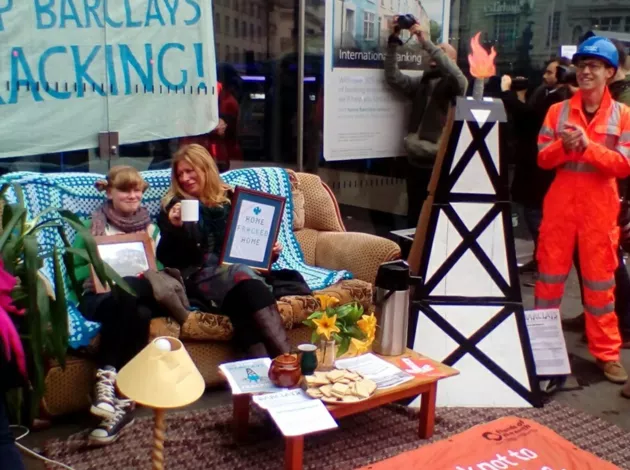
In over 90 branches of Barclays around the country, customers have recently been surprised to meet campaigners Bringing Fracking Home to Barclays. In various creative ways, these campaigners have highlighted the bank's ownership of Third Energy, who want to frack for shale oil in the beautiful North Yorkshire countryside.
In central London, removal men delivered a sofa to a prime spot outside the Piccadilly Circus branch of Barclays bank, where Nicky Holling, a resident from Ryedale and her daughter Ruby, were served Yorkshire tea and biscuits. There was music, dancing and speeches in what was a family friendly event, organised by groups including Friends of the Earth, Divest London, Frack Free Ryedale, 350.org, Sum Of Us, Frack Off London, Go Fossil Free and Reclaim the Power. Campaign against Climate Change supporters joined around 100 people assembled over the 90 minute protest which shut down the branch, many activists vowing to return until the bank get the message and divests.