We were deeply saddened to hear of the death of Michael Meacher. As one of the first politicians to wake up to the threat posed by climate change, he was prepared to fight for what he believed in. As honorary Vice President of the Campaign against Climate Change, he spoke out for urgent climate action in and outside Parliament - seen left speaking at a rally in support of workers fighting to keep the Vestas wind turbine factory open.
The ambitious plan of action for a Climate Emergency which he supported - rapid emissions cuts, sustainable transport, replacing short-haul flights with trains, major investment in renewable energy - stand in stark contrast with the current government's 'cuts at all cost'. We hope his legacy will inspire more MPs of all parties to stand up for the climate.
"I want our country to exploit all the natural resources we have. I want us to keep energy bills down and I want us to be part of that revolution, which can create thousands of jobs."
With these words David Cameron, at Prime Minister's Questions on 1st July, could have been expressing his support for developing onshore wind and other renewable energy resources - but he wasn't.
Instead he was responding to the question: "Given the Prime Minister’s commitment to localism, will he stand by and respect the decision made by Lancashire County Council this week to reject fracking, yes or no?". His answer started, "Those decisions must be made by local authorities in the proper way, under the planning regime we have. Personally, I hope that, over time, unconventional gas sites will go ahead, whether in Lancashire or elsewhere."
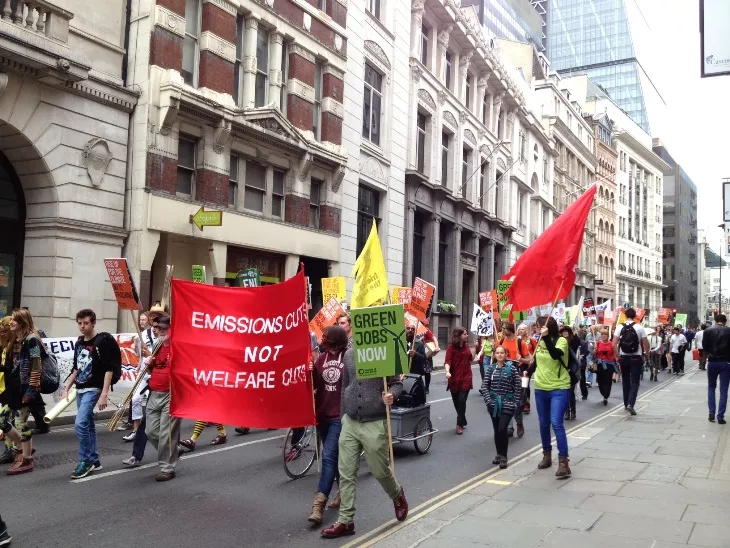
On Saturday 20th June 250,000 people marched together to protest against the impact that ''austerity' - government cuts now and planned for the future are having on people's lives, particularly the most vulnerable.
Activists from the Campaign against Climate Change, Friends of the Earth, Reclaim the Power and others came together in a 'climate bloc' because our chances of avoiding catastrophic climate change are also threatened by these short-sighted policies.
We have to invest in infrastructure across the UK that will give us a cleaner, safer, fairer future: renewable energy, public transport, warm homes for all. In doing this, much-needed jobs can be created. But instead, we are promised five years of cuts: cuts to the home insulation budget, cuts to bus services, cuts to cycling investment, and cuts to onshore wind subsidies, a vital form of clean energy. We can't afford to wait five years: scientists are telling us that urgent action is needed now to cut greenhouse gas emissions. Government must rethink its frantic cost-cutting for the sake of future generations.
On Saturday 20th June 250,000 people marched together to protest against the impact that ''austerity' - government cuts now and planned for the future are having on people's lives, particularly the most vulnerable.
Activists from the Campaign against Climate Change, Friends of the Earth, Reclaim the Power and others came together in a 'climate bloc' because our chances of avoiding catastrophic climate change are also threatened by these short-sighted policies.
We have to invest in infrastructure across the UK that will give us a cleaner, safer, fairer future: renewable energy, public transport, warm homes for all. In doing this, much-needed jobs can be created. But instead, we are promised five years of cuts: cuts to the home insulation budget, cuts to bus services, cuts to cycling investment, and cuts to onshore wind subsidies, a vital form of clean energy. We can't afford to wait five years: scientists are telling us that urgent action is needed now to cut greenhouse gas emissions. Government must rethink its frantic cost-cutting for the sake of future generations.
Obama of the United States and Xi of China have signed a bilateral climate agreement.
Much of the American and British media, and many Democrats in America, have hailed the deal as a key step forward. Many American Republicans have attacked it as going much too far.
Anything the Republicans attack has to be good. Right? No. In fact it is an appalling deal.
Let's look at the numbers.
The US has agreed to cut greenhouse gas emissions by 28% below 2005 levels by 2030. But 2005 was the highest year ever for US emissions. They have already declined 10% in 8 years. Obama is promising that they will decline another 18% in 15 years.
At the Campaign against Climate Change, we are currently supporting not one but two petitions to stop the government blocking wind energy projects that have already had local approval. Yes, that's right: blocking wind energy projects that have already had local approval.
That these petitions are necessary is mind-boggling. We all know that we are no longer in the days of 'greenest government ever' rhetoric. But you might have thought that the IPCC's recent dire warnings would have caused a moment's reflection, a touch of unease as to whether this is an appropriate response to the crisis facing humanity... apparently not.
The first petition, set up by Dan Grierson and hosted by 38 Degrees, refers to the Conservative Party's intended manifesto pledge to ban new onshore windfarms from 2020. The argument that they are doing this because wind farms are "unpopular" is a fascinating one, given the party's gung-ho support for fracking, a far less popular technology. DECC's most recent figures show a record 70% support for onshore wind, compared to 12% opposition.
Bob Crow died yesterday (11th March 2014), at the age of 52. Unexpectedly, of course. What everyone knows about Bob is that he was a fighter. He fought for his members, his class, and the railways. What not so many people have mentioned is that he fought for the planet too. In one way, it's simple - fighting for the railways is fighting against climate change and for the future of the planet. And railway jobs are climate jobs.