MPs hear from the media all the time about the 'net zero backlash' - they don't hear so much from the majority of their constituents who support urgent climate action. We're inviting our supporters to sign up for the Climate Coalition's mass lobby of MPs.
On Wednesday 9th July 2025, thousands of people from every corner of the UK will come to Westminster to tell their MPs:
Deliver vital funding to communities hit hardest by climate change here and around the world
Cut bills, back UK jobs, and secure a greener fairer future for all
Restore nature to create a safer, healthier future
You'll need to register as an individual to meet your MP. Groups are also invited to share their social media details / contact email address to network with others in their community ahead of the lobby
You can sign up to a training session:
How to connect with your MP – perfect for people engaging for the first time or in need of a refresh. 3rd, 4th & 16th June
Anyone thinking seriously about the accelerating climate crisis will know that to address it we have to think about money and power. A recent report found that extreme weather fuelled by the climate crisis has cost some of the world’s poorest countries $156bn over the past two decades, while climate negotiations have been dominated by the unequal struggle to get rich countries to pay up.
As climate campaigners, we don’t always lift the lid on the deeper economic injustice which underlies the need for climate finance - the fact that so many Global South countries are caught in a debt trap, which climate disasters only intensify, and which is a major barrier to climate action. In this webinar, hosted jointly with Debt for Climate and Debt Justice, we hear from Global South and UK campaigners for debt justice.
This year, 2025, is a Jubilee year, with the biggest global campaign for debt cancellation since the turn of the millennium. From 30 June to 3 July the Fourth International Conference on Financing for Development (FfD4) will be held in Seville, the first summit of its kind in over a decade, and reforming the debt system will be on the agenda.
In the UK and globally, firefighters are on the frontline of the accelerating climate crisis, fighting wildfires and flooding and seeing the devastating effects on communities and the environment.
TUC Congress last September passed strong motions recognising the severity of the crisis for all workers, and its industrial immediacy in sectors including fire and rescue; arguing for a rapid and just transition away from fossil fuels; and agreeing a year of trade union climate action linking up with community and climate justice groups.
The FBU has been a leader on labour movement climate policy and campaigning. Join us for a discussion on how we can do more to put that policy into grassroots action, and how firefighters and fire and rescue workers can play a major role in the coming year of activity and beyond.
Speakers:
Ben Selby, FBU Assistant General Secretary
Clara Paillard, Campaign Against Climate Change TU Group; Unite Grassroots Climate Justice Caucus
Chris Baugh, GMB Branch Chair (personal capacity) & former Assistant General Secretary of PCS
Andy Warren, London firefighter and London FBU NE Area Organiser
Chair and facilitator: Kasey LeGall, FBU B&EMM Secretary
At this year's TUC, Congress voted in favour of key climate policies. Composite 18 from Unison and PCS makes clear how climate is a class and Trade Union issue. The motion calls for an urgent end to fossil fuels, a national climate service, public ownership, huge investment in the jobs needed for a radical transition. It commits the TUC to a year of green Trade Union campaigning.
Join us to discuss the significance of this important motion, and how we turn these words into action.
Composite 5, from Unite and GMB, was passed narrowly on a card vote. It argued for the continued use of gas as part of the energy mix, and stressed 'no ban without a plan' regarding new licences for oil and gas exploration in the North Sea. It was opposed by many unions who want to see a ban and a plan.
Join us to discuss how we can shift the debate further in all unions.
Speakers:
Sarah Woolley General Secretary, BFAWU
John Moloney, Assistant General Secretary, PCS
Sean Vernell, UCU NEC
Liz Wheatley, Unison NEC
Clara Paillard, Unite Grassroots Climate Justice Caucus
Meeting organised by the Campaign against Climate Change Trade Union Group, co-sponsored by Unite Grassroots Climate Caucus and the Greener Jobs Alliance
The climate crisis is a class and trade union issue, already impacting the lives and livelihoods of working class people globally. Tackling it requires urgent action on fossil fuels and active leadership across the union movement is essential. This is not an issue any trade unionist can ignore.
It’s about communities having homes that are affordable to heat, decent public transport and clean air. It’s about public ownership of key services, and workplace health and safety. It’s about climate jobs, with a massive deployment of skilled labour needed across many sectors.
An end to fossil fuels, a just transition and a plan to deliver this and huge public investment in the transformation of the economy have never been more urgent.
Speakers:
Daniel Kebede, General Secretary, NEU
John Moloney, Assistant General Secretary, PCS
Liz Wheatley, Unison
Nick Mead, BFAWU
Chaired by Suzanne Jeffery, Campaign against Climate Change trade union group
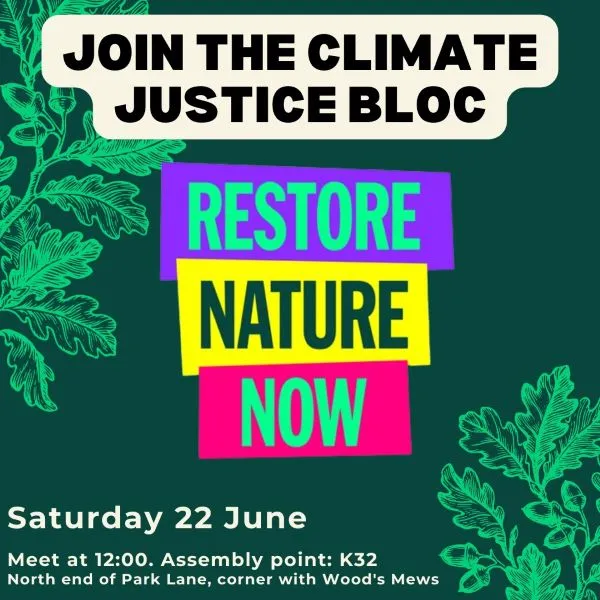
On Saturday 22 June, we'll demonstrate with thousands to demand restoration of nature and action for a liveable climate.
It will be just 12 days before the General Election - let's make our voices heard!
Over 150 organisations are supporting this national demonstration. There's more information about the day available on the Restore Nature Now website, including the march aims, route and accessibility information.
Assemble from 12 noon at Park Lane, London - meeting point near the north end of Park Lane (Marble Arch tube) at marker 32,near the corner with Wood's Mews.
Fighting for a huge transformation of the economy in the interests of people and the planet should be at the top of the trade union agenda. But it isn't. So how do we make sure the strength of the working class and trade union movement is at the heart of tackling the climate emergency?
Thank you to all who came and contributed to the lively discussions on these crucial issues. Thanks to volunteers stepping in to help with this, we have recordings of the plenary speakers and of the presentations in seven out of the eight workshops, available at the link above.
Resources
Text of presentations from the energy workshop (not recorded):
On Sunday 21st January, we'll be holding both the Campaign against Climate Change AGM and also our trade union group AGM. Both will be online. Our supporters are welcome to attend both or just one.
In 2023 our planet experienced unprecedented heating, breaking global temperature records by huge margins. In the face of this, there has also been a backlash against climate action in the UK, leading to Sunak's damaging backtracking. This year, the coming UK election does bring hope for desperately needed change. However, the power of vested interests cannot be underestimated. They push for the continuation of 'business as usual', but we know this is a myth. Inevitably, radical change faces us, whether it brings social justice and environmental protection, or further widens the gap between rich and poor in a climate changed world.
We'll be looking forward to 2024 and the fight to get the UK to finally kick its fossil fuel addiction. How can we get the Labour Party to commit to real investment in a climate just future, and how can we fight fossil fuel greenwash? This is a global struggle too. Amid mass protests for Palestine, the links between climate justice, neocolonial militarism and the fossil fuel industry are clearer than ever.
In our trade union group AGM these themes will continue to shape the discussion, but with a focus on the dividing lines in the trade union movement right now, and how to overcome these; building a clear consensus on climate change as a class issue, and looking towards our conference on 13 April.
The annual summit of all the countries which are part of the UN’s climate change treaty is known as the COP (Conference of Parties). The '28' in 'COP28' means that this will be the 28th such event. Many climate campaigners were not even born when this process started.
Yet after almost three decades global emissions are still increasing, even as temperatures rise and the impacts of climate breakdown multiply across all continents, hitting worst those who have done least to cause the problem.
From 30 Nov to 12 Dec, this year's summit will be hosted by the United Arab Emirates, a country planning a massive expansion of oil and gas production, and with no record of respecting human rights. It will be presided over by Sultan Ahmed Al Jaber, head of their national oil company.
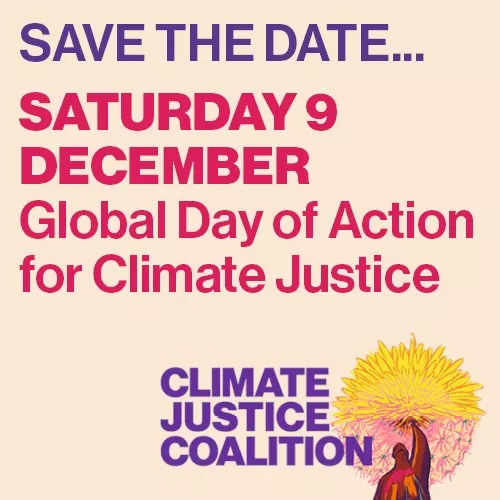
The global day of action will be on Saturday 9 December.