Wendy Smith is a Unite member, member of CACCTU and one of the founders of Norfolk Campaign against Climate Change.
People have been shocked at the recent news of deaths from extreme heat and flooding across the globe. Three of the world’s wealthiest men have been racing into space in an effort to find new sources of profit. Meanwhile our government here seems determined to rush the UK into a return to pre-pandemic business as usual. There has never been a more urgent need to fight for effective action in the face of climate catastrophe. The COP26 talks in Glasgow in November present our world leaders with a vital and timely opportunity to deliver more than vague targets and future promises.
The Campaign against Climate Change Trade Union group (CaCCTU) will be launching this autumn the eagerly-awaited update to their groundbreaking pamphlet, “One Million Climate Jobs”, first published in 2004. At the heart of this new report is a core model for a new public service – a National Climate Service – that can get the job done by seeing to the integration of training, redeployment, planning and the interface between sectors (e.g., between industries and energy, or the complex planning needed to integrate and balance public transport).
The Climate Jobs campaign argues we need a sustainable transformation of construction, transport and power among other sectors. Several unions organise workers in these industries and, in order to win the changes we need, these unions should get behind these demands, building support for a transition of the economy and for massive investment in well paid jobs which tackle the climate emergency. In particular, Unite, one of the biggest unions in the Britain, can play a crucial role. Unite is in the process of electing a new General Secretary.
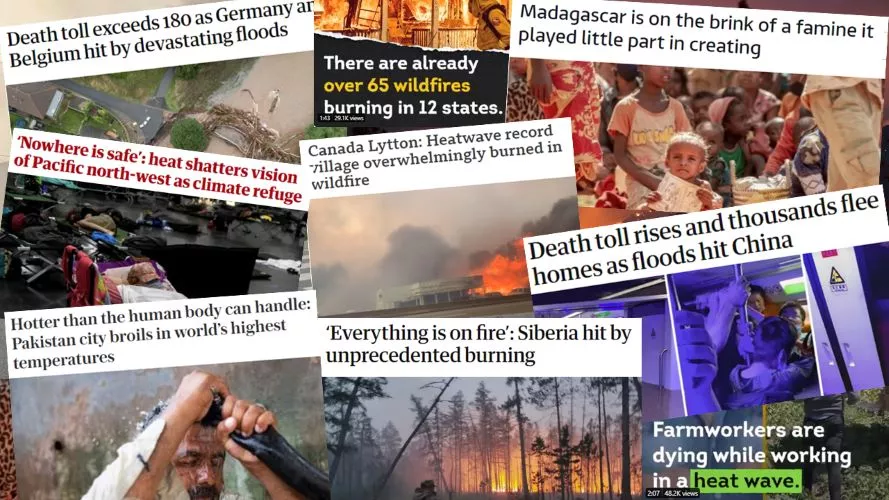
It's never been clearer that the climate crisis is here now. Below are news stories from just the past month describing extreme weather events and catastrophes from around the world. UPDATED 28 July
Some events are so extreme they could have not have occurred without climate breakdown, in other regions there is a trend of increasing frequency/severity. These events, alongside much worse predictions by scientists, should be enough to push world leaders into action on climate. But at best we see only half-measures and delay. Less than 100 days remain until the COP26 summit, and the UK government is issuing new oil drilling licences while ignoring the gap between its emissions targets and a lack of policies to meet them. We have to speak out and ensure the voices of those on the front lines of climate change are heard.
‘Nowhere is safe’: heat shatters vision of Pacific north-west as climate refuge. A 'heat dome' brought unprecedented heat to the US Pacific north-west and western Canada. Known for mild summers, cities were unprepared for record temperatures of up to 42.2C (Seattle) and 46.7C (Portland, Oregon). Some inland areas managed to get up to 118F (47.8C). Hospitals suddenly found themselves overwhelmed, with several hundred people believed to have died in the heat. The town of Lytton shattered the previous heat record for Canada (45C), reaching 49.5C before residents fled a devastating wildfire, which destroyed large parts of the town. Temperature records are usually broken by fractions of degrees.
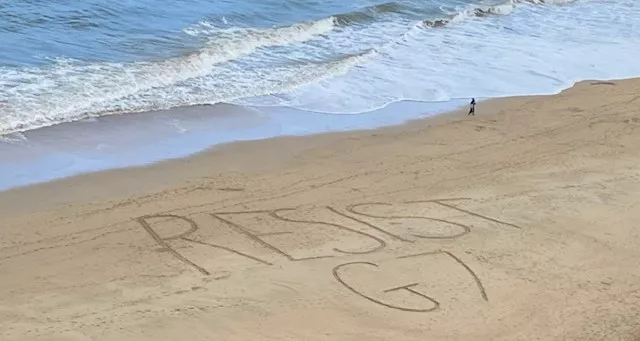
Tony Staunton is a member of the Campaign against Climate Change steering group and one of the founding members of the Resist G7 coalition, initiated by grassroots activists in Cornwall and the South West. Here he sets out how climate justice is not on the table at the G7 and the need to resist.
The G7 is a meeting of the world's most powerful political leaders, scheduled for 11th-13th June 2021 in the UK. These leaders govern the richest countries in the world in their own interests, and the G7 exists to keep it that way.
These government ministers will sit behind military security to meet at a luxury hotel complex in one the most picturesque but poorest regions of Europe - Cornwall. Resetting the global economy after the Pandemic will be the key discussion throughout, with the Climate Emergency centre-fold and used to dominate the media with messages of new economic growth through questionable "Green Technologies", promoted by billionaire Bill Gates and his ilk.
Global capitalism - the neoliberal free-market domination of the transnational corporations for agrochemicals, industrial agriculture, biofuels, together with the so-called Negative Emissions Technology (NET) of Carbon-Capture-and-Storage, mini-nuclear power plants and carbon trading - is the default setting.
The G7 wealthiest nations, hosted by UK Prime Minister Johnson, has invited India's Prime Minister Modi, currently assaulting millions of small farmers to enforce corporate dominance of food markets, and Australia's Morrison, the coal and uranium enthusiast.
The headlines from the G7 will be a prelude to what can be expected from the COP26 deliberations in November, once again led by the UK.
The Campaign against Climate Change is supporting the Resist G7 Coalition established soon after the venue was announced. Based in Cornwall, England, the Coalition has issued the call for action in every community, town and city with a day of action for Climate on Friday 11th June and an international manifestation of opposition to G7 neoliberalism on Saturday12th.
Local protests will take place in Cornwall, with convergence centres and counter-conferences in Penzance and Falmouth. The continuing risk from COVID variants makes the long journey to Cornwall by coach unsafe, and any physical protests called by the Coalition will seek to ensure ensure social distancing and personal protection.
Tony Staunton is a member of the Campaign against Climate Change steering group and one of the founding members of the Resist G7 coalition, initiated by grassroots activists in Cornwall and the South West. Here he sets out how climate justice is not on the table at the G7 and the need to resist.
The G7 is a meeting of the world's most powerful political leaders, scheduled for 11th-13th June 2021 in the UK. These leaders govern the richest countries in the world in their own interests, and the G7 exists to keep it that way.
These government ministers will sit behind military security to meet at a luxury hotel complex in one the most picturesque but poorest regions of Europe - Cornwall. Resetting the global economy after the Pandemic will be the key discussion throughout, with the Climate Emergency centre-fold and used to dominate the media with messages of new economic growth through questionable "Green Technologies", promoted by billionaire Bill Gates and his ilk.
Global capitalism - the neoliberal free-market domination of the transnational corporations for agrochemicals, industrial agriculture, biofuels, together with the so-called Negative Emissions Technology (NET) of Carbon-Capture-and-Storage, mini-nuclear power plants and carbon trading - is the default setting.
The G7 wealthiest nations, hosted by UK Prime Minister Johnson, has invited India's Prime Minister Modi, currently assaulting millions of small farmers to enforce corporate dominance of food markets, and Australia's Morrison, the coal and uranium enthusiast.
The headlines from the G7 will be a prelude to what can be expected from the COP26 deliberations in November, once again led by the UK.
The Campaign against Climate Change is supporting the Resist G7 Coalition established soon after the venue was announced. Based in Cornwall, England, the Coalition has issued the call for action in every community, town and city with a day of action for Climate on Friday 11th June and an international manifestation of opposition to G7 neoliberalism on Saturday12th.
Local protests will take place in Cornwall, with convergence centres and counter-conferences in Penzance and Falmouth. The continuing risk from COVID variants makes the long journey to Cornwall by coach unsafe, and any physical protests called by the Coalition will seek to ensure ensure social distancing and personal protection.
UK trade union leaders have written to the Chancellor calling on him not to cut funding from the Green Homes Grants scheme. They say removing around £1 billion from the scheme would jeopardise the UK’s chances of a green recovery, and put jobs at risk. With severe administrative problems caused by mismanagement of the scheme by US firm ICF, they also call on the scheme to be brought under public sector control.
Gail Cartmail, Unite Assistant General Secretary said, "The UK has some of the poorest housing stock in western Europe and 'fuel poverty' is rampant – so the need for a comprehensive housing renovation programme - with the 'green' agenda at its heart - is desperately required. The current failings in the Green Homes Grants scheme has been abetted by awarding the contract to a US firm, when, during the pandemic, it is the public sector that has more than proved its worth as the standard bearer of delivering services in a timely fashion. This contract should be brought back under public sector control immediately."
John Moloney, PCS Assistant General Secretary said, "The failure of Boris Johnson's Government to deliver on the Green Homes Grant – already at best a drop in the ocean initiative to tackle the climate emergency – exposes the truth about their world beating leadership on climate change and the large scale investment needed for a green recovery."
Suzanne Jeffery, Chair of CACCTU said "At a time of a jobs crisis and climate crisis and in the year UK hosts COP26, it's a dangerous and unnecessary failure. Cutting back this scheme threatens jobs and climate action."
It's not a good look for a country claiming to be a climate leader to be providing massive financial support for fossil fuel projects abroad. Last summer it was revealed that the UK government’s foreign credit agency, UK Export Finance (UKEF) with a history of backing fossil fuel projects will underwrite oil company Total's exploitation of Mozambique's gas reserves with loans and guarantees worth over one billion dollars. As well as climate pollution, this fossil fuel megaproject has also caused forcible evictions of thousands already and threatens local ecosystems.
Hit by accusations of hypocrisy, Boris Johnson finally announced in December that the UK would stop funding fossil fuel projects overseas.
But it appears that UK Export Finance, the UK's biggest funder of overseas fossil fuels, is still considering applications from at least 17 projects, including the gigantic East Africa Crude Oil Pipeline, which it could try to fund before the ban comes into place.
Our friends at Global Justice Now have set up a simple online action to allow you to respond to the government consultation and call for the ban to be:
- Immediate
- Comprehensive, disallowing technical assistance for fossil fuel projects and indirect investments
- Not allowing exemptions for gas, carbon capture and storage (CCS) or for any hydrogen produced using fossil fuels.
And that UK institutions and institutions in receipt of UK ODA should divest from their fossil fuel investments on the earliest possible time frame.
The deadline for responding to the consultation is Monday 8th February
Campaign against Climate Change stands in solidarity with the HS2 protesters at Euston. On 27th January, the National Eviction Team began their eviction of protesters from Euston Square Gardens.
Since August 2020, protesters have occupied the space in order to disrupt HS2’s work to build a taxi rank where 53 trees and a public green space used to be. Protesters have spent the past few months building treehouses and a 30-metre tunnel to make their eviction more difficult.
Reports from the site say that protestors have been denied food and water, and the NET are using torture tactics like depriving the activists of sleep. In the tunnel, there is a shortage of oxygen, five internal tunnel collapses and an influx of liquid mud. There have been reports that the NET are preventing the tunnellers from clearing soil and water from the tunnel. HS2 have also been breaching regulations that state that no machinery can be operated within 100 metres of the tunnel – they have been continuing construction and riding cherry pickers over the tunnel. These actions are completely inhumane.
HS2 is the most expensive infrastructure project in the UK, costing the taxpayer more than £100 billion. And yet its carbon benefits are highly questionable. Its construction will cause an estimated 8 to 14 million tonnes of CO2, with the first phase expected to be completed around 2030 and the full network by 2040. To set against this, over the first 60 years of operation HS2 Ltd estimated that it would save only 11-12 million tonnes of CO2. Therefore there is no strong evidence that the project will be carbon neutral even by the end of this century.
Considering the carbon reductions and job creation which could have been achieved with £100 billion invested in cutting car dependency through spending on buses, improving local rail services, cycling and walking, HS2 is a massive waste of money.
HS2 will destroy or irreparably damage 108 ancient woodlands, 693 wildlife sites (five of which are of international importance and protected by UK law) and 33 Sites of Special Scientific Interest as well as 1740 houses and businesses. HS2 has been made even more illegitimate by continuing work during the current pandemic, regardless of the dangers of the virus to the construction workers employed on the site and the communities they are part of.
All eviction efforts should be halted. We support HS2 protesters at Euston and every HS2 protester to date for their courage and bravery in the face of this destructive vanity project.
We've had the big announcement: Boris Johnson’s ten point plan for a ‘Green Industrial Revolution’. But following initial positive headlines, the details start trickling out. £12 billion was announced, but just £3 billion, it emerges, is new money. This is paltry. Other countries have already made much larger commitments, including Germany's green stimulus of over €40bn and France around €35bn.
Most importantly, how does it stack up compared to the scale of the task facing us? Two years on from the IPCC’s ground-breaking report calling for an urgent transformation of the global economy to stay within 1.5C above pre-industrial levels, global emissions are still (excluding the limited impact of the pandemic) on an upward trend. As temperatures continue to rise, sea level rise is accelerating as polar ice melts. And in the background a steady stream of records broken for ‘natural’ disasters like hurricanes and wildfires, hitting the poorest hardest.
The UK’s carbon budgets reflect out of date targets, an 80% cut in emissions by 2050. Previous policy failure means we are nowhere near on track to even stay within these deficient targets. This latest set of announcements is therefore doubly inadequate. It leaves a major hole in meeting even these out of date commitments. However we don’t just need to close that gap. Last year the government set a new climate commitment of ‘net-zero’ carbon by 2050. In relation to this new target, the gap is even greater. But unfortunately even ‘net zero by 2050’ doesn’t cut it. We need to act even faster than 2050 to be compatible with the Paris Climate Agreement.
Meanwhile, we also face a devastating pandemic leaving in its wake widespread unemployment. Now is the time for a real climate jobs programme to tackle the climate and jobs crises.
What would a real 10 point plan to tackle the climate crisis look like?
1. A comprehensive approach
Climate change cannot be tackled as an add-on, or a piecemeal approach that takes us one step forward, two steps back. We need a commitment that every economic policy, every spending commitment, every piece of legislation, will put us on track for a safer future, not jeopardise it by locking us in to business as usual.
If the government had really taken on board the scale of the crisis, it would be rethinking the policies of unconditional corporate bailouts, planning deregulation, aviation expansion, road building, stifling onshore wind. It would not be giving a £16.5 billion windfall to military spending.
2. Meeting the needs of both people and planet
Austerity has left us, more than ever, with a grossly unequal society with continued deep inequalities in race, gender and for disabled people. Underfunded public services are struggling. The move towards a zero carbon society must also ensure access to food, healthcare, education, income, job security, good, affordable, housing, clean and affordable energy and heat, public transport, clean air and green spaces for everyone.
There is huge public support to ‘build back better’ as part of recovery from the pandemic, investing in public services and frontline workers. Instead, a public sector pay freeze is being mooted. These are the wrong priorities: we need huge investment and expansion in the public sector and the people who work in it.
3. ‘New Deal’ levels of spending
Boris Johnson has tried to compare his plans to Franklin Roosevelt’s New Deal. In today’s money, Roosevelt’s spending programme amounted to about £4,300 – for every American living through the turmoil of the Great Depression. In contrast £12 billion is about £180 each.
Our own ‘One Million Climate Jobs’ report or Green New Deal plans give more of a sense of the levels of investment and ambition needed if the government is taking this seriously. Other recent analyses include an IPPR report which estimates that £33 billion a year in additional annual investment is needed to meet the government’s net zero target, creating 1.6 million jobs, including £8 billion on homes and buildings and £10.3 billion on transport.
The pandemic has shown that money can be found. It has been found for other spending, including billions to private companies for medical supply and services in contracts awarded with no oversight, regulation or transparency. These are the sums of money that now need to be directed into tackling the climate crisis, sums that can actually make an impact in reducing emissions and would truly justify the term New Deal.
We've had the big announcement: Boris Johnson’s ten point plan for a ‘Green Industrial Revolution’. But following initial positive headlines, the details start trickling out. £12 billion was announced, but just £3 billion, it emerges, is new money. This is paltry. Other countries have already made much larger commitments, including Germany's green stimulus of over €40bn and France around €35bn.
Most importantly, how does it stack up compared to the scale of the task facing us? Two years on from the IPCC’s ground-breaking report calling for an urgent transformation of the global economy to stay within 1.5C above pre-industrial levels, global emissions are still (excluding the limited impact of the pandemic) on an upward trend. As temperatures continue to rise, sea level rise is accelerating as polar ice melts. And in the background a steady stream of records broken for ‘natural’ disasters like hurricanes and wildfires, hitting the poorest hardest.
The UK’s carbon budgets reflect out of date targets, an 80% cut in emissions by 2050. Previous policy failure means we are nowhere near on track to even stay within these deficient targets. This latest set of announcements is therefore doubly inadequate. It leaves a major hole in meeting even these out of date commitments. However we don’t just need to close that gap. Last year the government set a new climate commitment of ‘net-zero’ carbon by 2050. In relation to this new target, the gap is even greater. But unfortunately even ‘net zero by 2050’ doesn’t cut it. We need to act even faster than 2050 to be compatible with the Paris Climate Agreement.
Meanwhile, we also face a devastating pandemic leaving in its wake widespread unemployment. Now is the time for a real climate jobs programme to tackle the climate and jobs crises.
What would a real 10 point plan to tackle the climate crisis look like?
1. A comprehensive approach
Climate change cannot be tackled as an add-on, or a piecemeal approach that takes us one step forward, two steps back. We need a commitment that every economic policy, every spending commitment, every piece of legislation, will put us on track for a safer future, not jeopardise it by locking us in to business as usual.
If the government had really taken on board the scale of the crisis, it would be rethinking the policies of unconditional corporate bailouts, planning deregulation, aviation expansion, road building, stifling onshore wind. It would not be giving a £16.5 billion windfall to military spending.
2. Meeting the needs of both people and planet
Austerity has left us, more than ever, with a grossly unequal society with continued deep inequalities in race, gender and for disabled people. Underfunded public services are struggling. The move towards a zero carbon society must also ensure access to food, healthcare, education, income, job security, good, affordable, housing, clean and affordable energy and heat, public transport, clean air and green spaces for everyone.
There is huge public support to ‘build back better’ as part of recovery from the pandemic, investing in public services and frontline workers. Instead, a public sector pay freeze is being mooted. These are the wrong priorities: we need huge investment and expansion in the public sector and the people who work in it.
3. ‘New Deal’ levels of spending
Boris Johnson has tried to compare his plans to Franklin Roosevelt’s New Deal. In today’s money, Roosevelt’s spending programme amounted to about £4,300 – for every American living through the turmoil of the Great Depression. In contrast £12 billion is about £180 each.
Our own ‘One Million Climate Jobs’ report or Green New Deal plans give more of a sense of the levels of investment and ambition needed if the government is taking this seriously. Other recent analyses include an IPPR report which estimates that £33 billion a year in additional annual investment is needed to meet the government’s net zero target, creating 1.6 million jobs, including £8 billion on homes and buildings and £10.3 billion on transport.
The pandemic has shown that money can be found. It has been found for other spending, including billions to private companies for medical supply and services in contracts awarded with no oversight, regulation or transparency. These are the sums of money that now need to be directed into tackling the climate crisis, sums that can actually make an impact in reducing emissions and would truly justify the term New Deal.
Climate breakdown cannot be a niche issue - it has to be a priority for us all. So we should welcome the Net Zero Festival, run by BusinessGreen, as an attempt to wake up mainstream businesses to the necessity of rapid transition to net zero carbon. As exemplified by sponsors…
...Heathrow, Drax, Shell?
Hang on. Finding these names among the sponsors, one can hardly fail to notice that they are hardly companies usually held up as examples of climate leaders. What is going on? Is Shell switching from oil and gas to renewables and we somehow missed the announcement?
Unfortunately not. What Shell actually produced earlier this year is a ‘net zero carbon plan’. This promises to cut a small part of the company’s own emissions (those unrelated to burning the oil and gas it extracts) to net zero by 2050 by offsetting. As for the majority of Shell’s emissions which come from customers burning its product, there is no target to reduce total emissions, let alone reduce oil and gas production. Instead, Shell promises to reduce ‘carbon intensity’ by two thirds. This could be by increasing production of renewable energy and biofuels alongside oil and gas, and also offsetting. It further promises to work with customers who burn its product to ensure they capture the carbon or offset emissions.
Interesting. However, notable by their absence from Shell's plan are any proposals to stop exploring for new oil and gas; to halt new extraction; to phase out production in the short or long term; or to invest in a just transition for workers. Before the pandemic, Shell was planning more than 35 new oil and gas projects by 2025. Half of the 24 “major projects” in its investment profile are deep water oil and gas projects, which it says have “significant growth potential.”