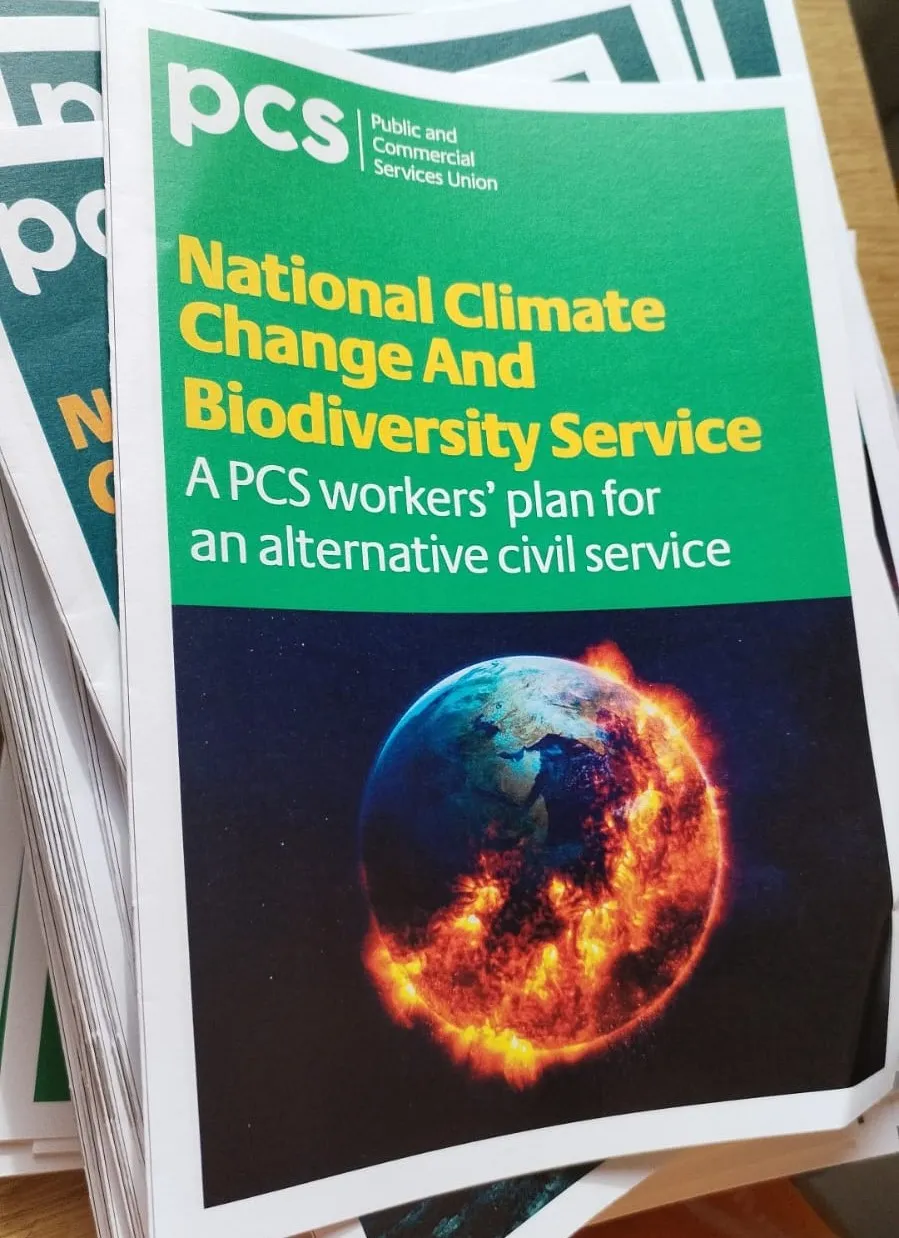
PCS Union was closely involved with developing the original One Million Climate Jobs campaign. As climate disasters intensify, global emissions rise, and the gap widens between UK climate targets and effective polices to achieve them, the need is greater than ever for a comprehensive climate jobs plan to cut emissions across all sectors. For PCS, we know this necessary transformation cannot be implemented effectively as the Civil Service is not designed to deliver a long term plan that requires the greatest degree of cross departmental working. That is why we have proposed the National Climate and Biodiversity Service, which would join together all net zero work in the UK Civil Service so that government operates as a coherent whole.
Faced with the government's backtracking, driven in part by misguided electoral calculations (as part of their war on woke and the alleged war on the motorist), we must redouble our efforts. Both in the trade unions and in the climate change movement we need to work together convince workers and the public that the government is wrong, but also to take the necessary actions to get this government and any future ones to adopt the right polices.
The full text of the new pamphlet is below, you can also
National Climate Change and Biodiversity Service: A PCS workers’ plan for an alternative civil service
The era of global warming has ended and “the era of global boiling has arrived”, the UN secretary general, António Guterres, has declared.
In those circumstances, the notion that it is business as usual for the Civil Service or society as a whole, clearly is not sustainable. There needs to be a radical overhaul of how the UK Civil Service works. This would only be one element in the solution – you still need political will and a plan – but without effective state mechanisms there is no hope in ensuring net zero.
Sunak's dangerous backtracking on policies for net zero, in a craven attempt to win votes for an unpopular Tory government, is a disaster for the planet and does nothing to tackle the cost of living crisis. Every trade unionist should challenge and join campaigners in opposing this.
Sadly there is nothing new in backtracking on climate pledges from the Tory party in government. But we should expect different from trade trade union leaders.
This summer has shown the devastating impacts of climate change. Several thousand lives have been lost in Libya as a result of the most serious climate event to date, yet senior trade union figures are arguing for more fossil fuel extraction in the name of defending jobs.
Both GMB General Secretary Gary Smith and Unite General Secretary Sharon Graham want the Labour Party to reverse its decision not to grant new licences for extracting oil and gas from the North Sea.
Gary Smith claims ‘We’ve cut carbon emissions by decimating working class communities”. This is nonsense. Mining communities were destroyed for economic reasons and to break one of the best organised trade unions in Britain. It was not to reduce carbon emissions. British pits were considered uneconomic and were replaced with cheaper imported coal. The years of austerity and falling real wages account for what has happened since.
Allowing uncontrolled climate change would be the ultimate assault on working class communities in Britain and across the world. That is why we urgently need to transition away from fossil fuels in a way that protects workers rather than the profits of the fossil fuel companies.
The science is absolutely clear. The more carbon and other greenhouse gases are pumped into the atmosphere, the greater global warming, and the more devasting the impact on the climate and our lives.
We already know that climate events happen with little or no warning and can have a catastrophic consequences for those impacted. People can lose not just their jobs, but also their homes and even their lives.
Far from defending jobs, demanding new licences for another 30 years of even more carbon emissions actually puts jobs at greater risk of coming to an abrupt end, either from climate events or their economic consequences.
Our Climate Jobs report, 'Building a Workforce for the Climate Emergency' shows that to successfully transition away from fossil fuels it will be necessary to recruit, train and deploy many more workers than those currently working in fossil fuel related industries. It will take time to do this so we need to start now.
Instead of pandering to the interests of the fossil fuel industry and its Government supporters, the trade union movement must use its full weight to demand that employers and Government urgently create and invest in the climate jobs and the just transition that we need to secure the future of us all.
If you want to campaign for urgent climate action within the trade union movement as well as jobs, then join us.
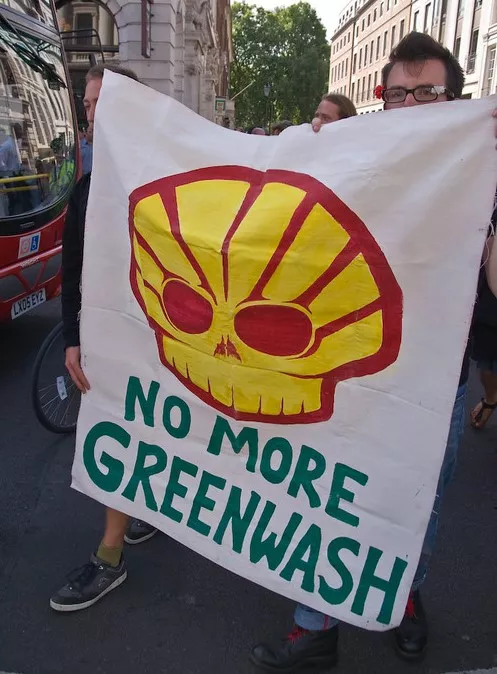
This Tuesday, it's Shell's AGM in London. If you can, do come and join the protest:
When: 23 May, from 9am
Where: ExCel London, Royal Victoria Dock, 1 Western Gateway, London E16 1XL
They will be celebrating their obscene profits - £7.6 billion over the first three months of 2023, almost £1000 every second - and obscuring the truth about the impact on people and the planet with greenwash.
So lets get our facts straight about Shell and their corporate cronies:
1. We can't afford any new fossil fuel infrastructure
Climate scientists have been warning for years that we need to keep fossil fuels in the ground. In 2021, even the International Energy Agency did the maths and concluded there could be no new fossil fuel infrastructure. But fossil fuel companies and governments never got the memo. They continued drilling, building pipelines and exploiting new fossil fuel fields. Analysis last year found just eight oil and gas companies to be involved in over 200 expansion projects
2. Shell and other companies are making record-breaking profits because the rest of us are getting poorer
Last year, the West’s five largest oil and gas companies, Chevron, ExxonMobil, Shell, BP and TotalEnergies made $134 billion in excess profits, (profits in addition to what they would normally expect). These profits came from higher energy bills, taken from households and from businesses which then passed on the higher costs to consumers. The cost of living crisis in the UK is part of a wider global crisis caused in large part by energy companies profiteering from the war in Ukraine.
3. The UK's planned North Sea oil and gas expansion would be a climate disaster
4. Fossil fuel expansion doesn't help workers or those of us struggling with the cost of living.
Can North Sea oil and gas help with UK energy bills? No - the vast majority of what will be produced is oil, not gas, and will be owned by the companies extracting it and exported. Longer explanation here.
But will it help the UK economy? Also no. The windfall tax ('energy profits levy') which Rishi Sunak brought in last year came with a giant loophole - a tax break for oil companies opening up new fields for drilling. For Rosebank, this would mean UK taxpayers handing back £3.75 billion.
A just transition is possible. Recent research by Platform and Friends of the Earth Scotland with oil and gas workers sets out their concerns about working conditions, fears for the future, and what they need for a just transition: making it easier for oil and gas workers to move into the renewable industry; ensuring safety, job security and fair pay across the energy industry; new public owned energy companies and a tax regime that works for the public good.
5. Greenwash enables destruction.
Companies like Shell and BP produce a barrage of advertising on social media and elsewhere, with prominent photos of wind turbines and solar panels. But in 2021 Shell invested just 1.5% of its total capital expenditure ($244 million out of £19.7 billion) in wind and solar.
So what makes up the rest of its so-called 'Renewables and Energy Solutions' expenditure ($2.4 billion in 2021)? Analysis by Global Witness revealed this included not just 'solutions' such as carbon capture and storage (CCS), hydrogen and carbon offset projects but also marketing and trading of fossil gas.
Government subsidies are also being diverted to false solutions. A recent leaflet produced by our trade union group sets out the facts behind the greenwash around carbon capture, hydrogen and biomass in the UK.
We have also increasingly seen the capture of UN climate negotiations by fossil fuel interests and consequent greenwash - a huge concern for this year's COP28 to be held in UAE. (more detail here)
There is a long history of juries acquitting activists in criminal cases on the basis that they are acting to prevent a greater wrong. But the right for defendants to tell the truth and give the context for their actions is under threat.
In an outrageous decision, Judge Silas Reid has instructed climate protesters facing criminal charges not to refer to climate change as a motivation for their actions. When, in his defence statement, David Nixon mentioned the subject of insulation and its relation to climate change the judge jailed him for eight weeks for contempt of court.
In March 2023, despite the substantive case against them collapsing, Dorset councillor Giovanna Lewis, 65, and horticultural worker Amy Pritchard, 38, were jailed for seven weeks for contempt of court for talking about fuel poverty and climate change in court. Judge Reid told the defendants they had sought to "set themselves above the law" by mentioning aspects of their motivation in carrying out the October protest that were not relevant to jury deliberations. He concluded that the defendants had either set out to "manipulate" the jury into acquitting them even if they were sure of the pair's guilt, or to use the trial to continue their protest within the courtroom.
A number of climate activists have been held for long periods on remand, in prison ahead of being found guilty for months at a time. Louis McKechnie was one of them. The JSO activist was held for 7 months without a trial after tying himself to a goalpost at a Premier League football game and participating in other actions. the cases of many more Just Stop Oil activists can be seen here.
Keeping legal courts and judiciary separate from political decision-making is a pre-requisite of a democratic state. The human right to manage your own defence at law, and sum up your case as you see it has been enshrined in UK law but is now at an end. To prevent an explanation of intent on the basis that it may influence the jury is a political action by the court.
Climate activists, and anyone concerned for the state of democracy in Britain today should be concerned and activated by these decisions. Political censorship inside the judicial system has now effectively created political prisoners.
The Campaign against Climate Change has long called for support for climate protesters facing court action or sentenced for protesting. We are calling on all campaign groups and individuals to challenge the judgements of Silas Reid, raising the issue with MPs and human rights organisations.
The right to protest, and the very basis of democracy is under attack.
In 2021, then Home Secretary Priti Patel said: "The right to protest is a fundamental principle of our democracy but we will not tolerate guerrilla tactics that obstruct people going about their day-to-day business". Boris Johnson, Prime Minister at the time, added: "This government will always stand on the side of the law-abiding majority and ensure the toughest penalties possible for criminals who deliberately bring major roads to a standstill. We will give the police the powers they need to stop their reckless and selfish behaviour." See more here
The UK government of Prime Minister Rishi Sunak and Home Secretary Suella Braverman have expanded those pledges, now curbing the right to strike as well as identifying asylum seekers as illegal human beings who may be deported to Rwanda without being allowed to present their case for refugee status.
We're supporting the Extinction Rebellion call-out for the 'BIG ONE' mobilisation, involving more than 200 groups and organisations gathering around Parliament 21-24 April.
It's clear that the multiple crises we face are interlinked: irreversible climate breakdown, spiralling cost of living and poverty, and attacks on fundamental rights to protest and strike. So let's make sure this message is heard with plenty of trade union banners and placards on the action!
Friday 21 April
'People's pickets' outside government departments, with many different groups coming together to organise these. CACCTU will be at the "Department for Energy Security and Net Zero" (DESNZ), along with other groups including Fuel Poverty Action, Stop Rosebank, Just Stop Oil and Biofuelwatch and more.
Activists will be there from 7am to allow engagement with workers as they arrive. The 'pickets' will continue throughout the day until 6pm, though key times are likely to be12 noon to 2pm when workers are coming and going, and activists coming for the day are most likely to be around.. At 3pm there will also be an 'opening ceremony' in Parliament Square.
PCS Union are supporting the action but will not be asking members to come out during core hours, only at lunchtime. Note that "People's Pickets" are to be inclusive and accessible, and won't block access to the buildings.
Some trade unionists will be planning to attend other picket sites with their local groups or specific campaigns. There is a map showing the locations of the different government departments.
Saturday 22 April
The trade union hub will be opposite the south end of the Houses of Parliament, just past 'Old Palace Yard' where the health, education and science hubs are based. CACCTU will be there along with XR TU and other trade union climate groups. We'll have speakers and discussion from 11-1pm, about how trade unions and climate activists can and must work together, the solutions we need, and those we don't. Please come and join us if you can!
11am - Welcome! Trade unions and climate activism
Daniel Randall, RMT and XRTU
11.10 - The changes we need
Climate jobs - Suzanne Jeffery, CACCTU; Avoiding greenwash - Ellen Robottom, CACCTU; Offshore workers’ demands for a just energy transition - Rosemary Harris, Platform; Cumbria coal mine and green jobs - Hazel Graham; plus open discussion
11.40 - Climate/green networks in trade unions
NEU Climate Change Network - Paul Atkin; Equity For a Green New Deal; Unite Grassroot Climate Justice Caucus - Clara Paillard; plus open discussion and networking
12.10 - Democracy - workers and climate
Workers Assemblies - Finlay Asher, Safe Landing; Green reps (tbc)
12.25 - Organising locally (speakers and open mic)
Carol Mills, Eastbourne Trades Council, plus other speakers
From 1pm CACCTU will be joining other trade union climate activists for a Trade Union bloc on the march for biodiversity – please bring your TU flags and banners.
Call to action for Unite members: the deadline for branches to submit motions to be debated at the July policy conference is 31st January.
The recently formed Unite Grassroots Climate Justice Caucus is seeking to get the same motion submitted by as many branches as possible. These were chosen with the aims of keeping the motions simple and focusing on the top priorities that emerged during Caucus meetings. Caucus members are asked to choose one of these two motions.
Each Unite branch can submit one motion only (unfortunately Unite Community branches cannot submit motions, though in some cases they may have influence with their local geographical or sector-based branches). Your Branch Secretary should have circulated the information including Conference forms for motions. If not, you still have time to contact them and ask for a Branch meeting to take place before the conference deadline in January, to select a motion. Branch members would have to have enough notice to consider the motion (and any other motions on the table) before agreeing what to submit to conference.
No new fossil fuels motion: Currently Unite's policy is to support continued fossil fuel extraction and is using Carbon Capture and Storage as the justification for doing so. This motion aims to push for the end of support for new extraction but does not mention existing production at this stage because the motion would be lost given the number of workers Unite represents in fossil fuel industries. But, if won, this would be a start. Motion text
Workers Assemblies in key sectors motion: Not many of the Caucus members work in industries such as fossil fuels, chemicals, automotive or aviation. However, if you do, you may want to push for this motion to be sent to conference as it argues for Workers Assemblies to take place in all sectors to move forward the Climate Justice & Just Transition agenda. Motion text
Unite members can join the Climate Justice Caucus here.
You can also get in touch to inform the caucus about motions being submitted via CACCTU on climatetradeunion@gmail.com
Unite Grassroots Climate Justice Caucus is an unofficial group of members of Unite the Union who want to link up and organise at grassroot level to improve how Unite approaches Climate Justice.
We have written, along with the Greener Jobs Alliance and the Climate Justice Coalition, to key public service unions striking for decent pay and conditions to express our solidarity. Many CACCTU supporters will have already expressed solidarity to local union branches in a similar way, if not, we encourage you to do.
For more about encouraging climate activists to support the strikes, see here
Below is our letter, in a general form which can be adapted for particular disputes.
As trade unionists and activists campaigning on the climate crisis, the organisations represented in this letter wish to express our unequivocal solidarity with your dispute. We stand with you in your fight against the cost of living crisis and against threats of further austerity policies which would bring even worse suffering.
The information below, provided by our trade union group, is intended as a guide for climate activists on supporting striking workers. Of course, 'climate activists' and 'workers' are not mutually exclusive! Join a union
Workers on picket lines are challenging the power of their employers, showing bravery and determination and deserve respect. The long days of picketing, cold and wet through the winter, allow plenty of time to build comradeship, find common interests, explore ideas and discuss issues of the day. For millions of trade unionists in the UK, the issue of the cost-of-living crisis is forefront in current struggles. For climate activists the costs to people and planet of the current fossil fuel economy is urgent. For both, we need system change.
As the climate catastrophe deepens, the need for cheap renewable energy to end reliance on fossil fuels will require radical action to ensure people's homes are insulated and transport is electrified using wind and solar energy generation. The fight of workers to be able to afford to heat their homes and travel to work becomes a fight to end the super-profits of oil and gas corporations and stop investment in new coal mines and oil fields when the money should be used for investment in renewable energy and climate jobs.
Whilst the cost of living crisis involves a rate of inflation at above 11%, the current price inflation of staple foodstuffs is running at between 18-30% a year in the UK. The extreme weather events this year alone, caused by accelerating heating of the planet from gases emitted from current methods of production, has seen food harvests severely affected and some completely destroyed, here and across the world leading to food-price hikes and, in the worst cases, famine.
In the media, public sector strikes are often presented as being solely about pay. In fact they are broader than that, and are a fight against cuts damaging public services which provide the essential social infrastructure of this country. And in some cases these services play a key role in reducing emissions, for example public transport.
In the short term, rail unions have basic demands like safe staffing levels being maintained. In the long term they generally call for renationalisation of rail. This links directly with climate action: to cut emissions we need investment in electrification of rail, bus and coach services and an integrated not-for-profit public transport system, affordable and dependable to move passengers and freight out of polluting cars and lorries. The strike action is therefore directly linked with environmental issues, and that discussion can encourage trade unionists to take-up climate demands inside their union and with the employer.
The main headline from COP27: after twenty-seven years of climate negotiations, progress on actually cutting emissions is as painfully slow as ever. Meanwhile the chance of staying under 1.5C of warming is rapidly disappearing, and the impacts of climate breakdown are devastating communities around the world.
The Egyptian government saw hosting the summit as an opportunity to enhance prestige, but the international attention also shone a spotlight on its human rights abuses, with a crackdown on protesters ahead of COP27. The most powerful voice at the summit was arguably a man who who was not even in Sharm el-Sheikh, but in prison. Alaa Abd El Fattah, a British-Egyptian pro-democracy activist and writer, who has been in prison for most of the past nine years, escalated his ongoing hunger strike to stop drinking water as COP27 began.
Due to the restrictions imposed on protest in the streets of Egypt , for the first time ever, climate activists marched within the Blue Zone (governed by UN rules). Their slogan, "We have not yet been defeated" echoed the the title of Alaa Abd El Fattah's book of essays, You Have Not Yet Been Defeated. Solidarity climate protests around the world called for the freeing of Alaa and the many other political prisoners in Egypt, that there could be no climate justice without human rights.
Loss and Damage fund finally established
COP27 did produce one big win for countries on the frontline of climate breakdown. After decades of blocking by rich nations, a loss and damage fund was agreed for countries most affected by climate change to cover devastating impacts like flooding and drought. In the run up to COP27, negotiations had been needed to even get loss and damage onto the agenda. This fund is a significant win for powerful advocacy by climate-vulnerable countries and the global climate justice movement, and one which was fought over all the way.
But the new loss and damage fund is, for now, empty. The track record of rich nations on climate finance is not encouraging. Thirteen years ago in Copenhagen, rich nations pledged to provide US$100 billion a year to less wealthy nations by 2020, to help them adapt to climate change and develop sustainably. That promise was broken, not just falling short on the total amount, but also in the substance of what has been provided, which has overwhelmingly been given as loans only, rather than grant funding.
The main headline from COP27: after twenty-seven years of climate negotiations, progress on actually cutting emissions is as painfully slow as ever. Meanwhile the chance of staying under 1.5C of warming is rapidly disappearing, and the impacts of climate breakdown are devastating communities around the world.
The Egyptian government saw hosting the summit as an opportunity to enhance prestige, but the international attention also shone a spotlight on its human rights abuses, with a crackdown on protesters ahead of COP27. The most powerful voice at the summit was arguably a man who who was not even in Sharm el-Sheikh, but in prison. Alaa Abd El Fattah, a British-Egyptian pro-democracy activist and writer, who has been in prison for most of the past nine years, escalated his ongoing hunger strike to stop drinking water as COP27 began.
Due to the restrictions imposed on protest in the streets of Egypt , for the first time ever, climate activists marched within the Blue Zone (governed by UN rules). Their slogan, "We have not yet been defeated" echoed the the title of Alaa Abd El Fattah's book of essays, You Have Not Yet Been Defeated. Solidarity climate protests around the world called for the freeing of Alaa and the many other political prisoners in Egypt, that there could be no climate justice without human rights.
Loss and Damage fund finally established
COP27 did produce one big win for countries on the frontline of climate breakdown. After decades of blocking by rich nations, a loss and damage fund was agreed for countries most affected by climate change to cover devastating impacts like flooding and drought. In the run up to COP27, negotiations had been needed to even get loss and damage onto the agenda. This fund is a significant win for powerful advocacy by climate-vulnerable countries and the global climate justice movement, and one which was fought over all the way.
But the new loss and damage fund is, for now, empty. The track record of rich nations on climate finance is not encouraging. Thirteen years ago in Copenhagen, rich nations pledged to provide US$100 billion a year to less wealthy nations by 2020, to help them adapt to climate change and develop sustainably. That promise was broken, not just falling short on the total amount, but also in the substance of what has been provided, which has overwhelmingly been given as loans only, rather than grant funding.