


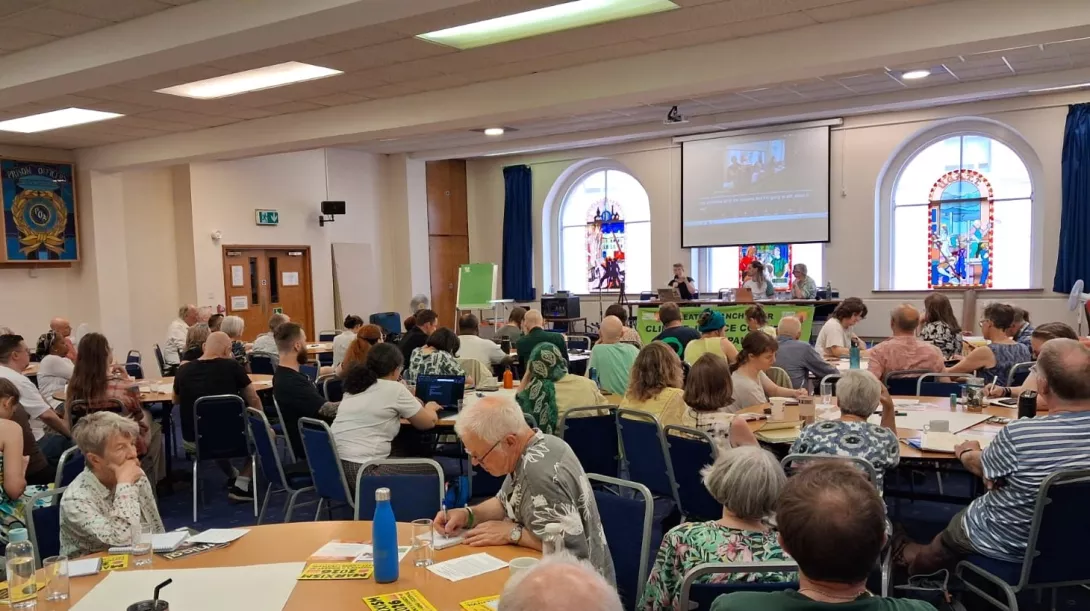
This conference was a great opportunity to discuss the many issues around AI and data centres and the ways in which trade unions and campaigners are working to protect people and the environment. You can read a report from the day below, and also watch the video of speakers. The full transcript is here, and slides linked below.
UPDATE: Since the conference, Microsoft released emissions data showing an increase of 25% in the past year alone, matching Google's increase of 25% and Amazon 16%, all leaving previous climate pledges stranded in the dust.
Session 1: The uses of AI in war and surveillance
Speakers: Anne Alexander, a researcher and journalist covering the social, ecological and political impacts of AI systems, currently working on a forthcoming book on the AI Arms Race; Rory Gibson, Medact, No Palantir in the NHS
Session 2: The climate and environmental impacts of data centres
Speakers: Mary Stevens, Friends of the Earth (Mary's slides available here); Owen Espley, Global Action Plan (selected slides from Owen's presentation here)
Session 3: How AI is affecting our jobs and wider society, and the action that trade unions are taking
Speakers: Shireen Asaw, United Tech and Allied Workers; Simeon Gill, President of University of Manchester UCU; Laurence Bouvard, Equity, Screen and New Media Committee member; Clara Paillard, Unite not-for-profit sector; Ian Allinson, Troublemakers at Work network.
The conference was organised as part of the trade union year of climate action - many thanks for donations from PCS, MMU UCU, Trafford Trades Council and Stockport Unison.
You can also view our earlier webinar in February here: AI & data centres: a new climate threat
First published on North West Bylines
Launching the AI Action Plan last year, the government announced that their plan was intended to “mainline AI into the veins of this nation”. Keir Starmer’s unquestioning enthusiasm for AI may be shared by his successors in government, and by corporations. However, ordinary people have questions and concerns, and find it deeply frustrating when these are brushed aside as trivial. “It’s happening, whether you like it or not”.
What do we need to know about AI and about the data centres being built to enable it? To find some answers, trade unionists, environmental campaigners and concerned citizens gathered in Manchester at the Mechanics Institute for a conference co-hosted by the Greater Manchester Climate Justice Coalition and the Campaign against Climate Change, “This Is Not Inevitable: Standing up to AI and Big Tech”.
One of the recurring themes of the day was that adding up the impacts of data centres requires very big numbers. When we talk about data being stored in ‘the cloud’ this can obscure the physical reality and vast scale of the infrastructure being created to run and train these systems.
Owen Espley, from environmental NGO Global Action Plan, which has been mapping and challenging the UK data centre build out, told attendees, “The International Energy Agency estimates that a typical AI-focused data centre consume as much as 100,000 households. Some of them that we're seeing built are 20 times that amount.”
“Recently, Ofgem released in a consultation a figure saying that there were 140 proposed data centres that applied for grid connections and they would require 50 gigawatts of energy. They also mentioned that on a peak electricity day, the UK used 42 gigawatts of electricity. So we're talking about an energy demand that would double the amount of electricity that the UK needs to produce.”
Globally, especially in the US, the scale of the construction is staggering. Owen Espley reported that the most recent estimates are that around $7 trillion would be spent by the biggest tech companies by 2030. This amount of money would be the modern equivalent of 13 times the cost of building the US highways network, which took five decades.
Most of these data centres are powered by fossil fuels, with alarming consequences for the climate. One of the key demands some campaigners are focusing on is that data centres must be powered only by new additional renewable energy. However, they may still cause a problem by competing with the transition to clean energy for other uses. In Ireland, where data centres already account for 22% of total electricity consumption, between 2018 and 2023, 100% of the country’s new renewable capacity went to data centres.
Global Action Plan are demanding a UK moratorium on data centres until there is a national framework on what is required, and clear limits on acceptable local (and cumulative national) energy and water impacts.
Mary Stevens, from Friends of the Earth, also drew attention to the materials required. “A lot of this infrastructure relies very heavily on cobalt. 70% of the world's cobalt is sourced from the Democratic Republic of Congo. In just one mining community in the Democratic Republic of Congo, an area called Kolwezi, there are around 40,000 children working in what's called artisanal mining. Artisanal mining is the very euphemistic word for a very, very brutal practice.”
“Most of the infrastructure in the servers and so on that are being constructed at the moment are estimated to have a lifespan of 5 to 6 years. Which means that by 2030, AI servers could generate between 130,000 and 225,000 tons of e-waste every year.”
Of course, it’s not just how data centres are built and powered that is causing concern, it’s what AI may be used for. The most shocking examples of this came up during the first session on AI in war and surveillance. Researcher and journalist Anne Alexander described Israel’s AI systems for calculating who might be Hamas militants and calculating when these people might be at home to be killed with their family. She stressed that this was no ‘rogue AI’ scenario, but all based on decisions made by humans, such as how many civilians are allowed to be killed in a strike (at least 20).
Rory Gibson from Medact then spoke on behalf of the No Palantir in the NHS campaign. He described how a widespread campaign has mobilised nationally and across grassroots local groups in response to Palantir, a company complicit in human rights abuses, being given the contract for the NHS Federated Data Platform, also known as the FDP.
There have been significant wins, such as the BMA urging its members to boycott the use of Palantir, and Greater Manchester Integrated Care Board deciding not to adopt the FDP, with the ultimate aim that the government exercise the break clause in the contract.
Since the conference was taking place as part of the Trade Union Year of Climate Action, there were also a range of contributions from trade unionists talking about the impact of AI in the workplace.
Shireen Asaw of United Tech and Allied Workers believed the technology of AI was not in itself the problem, but how it is used, “in the hands of billion pound corporations acting in the interests of their shareholders”. Speaking via video link, because of heatwave-related transport disruptions, she reminded the audience that every summer we break another temperature record, while companies are racing to build one of the most energy-hungry technologies that humanity has ever created.
She also highlighted AI’s ‘ghost workers’. “Millions of people around the world spend their days labelling images, transcribing speech, reviewing content, correcting AI mistakes, and producing the data that these systems need to function.”
“If technology simply moves work somewhere where workers have fewer rights, that's not innovation. That's outsourcing with better marketing.”
Linked to this, she suggested “Every time a CEO says that AI is replacing workers, I think we should ask the question, is it really AI or is AI becoming a convenient excuse to make decisions that companies already wanted to make?”
This was also echoed by Simeon Gill, president of the University of Manchester University College Union, who felt that management may use workers being replaced by AI as a threat, even when it’s impossible for AI to do what humans do. Within the university he reported that the Students Union was strongly pushing back, however the higher education sector as a whole should be speaking out more strongly against AI as a replacement for critical thinking and skills.
Laurence Bouvard, chair of Equity’s Screen and New Media Committee, spoke about the double threat that AI companies pose to performers: replacing them in jobs such as adverts, reading audiobooks; and doing this by stealing their voices, performances, and likenesses, training their algorithms on their data with no compensation. She warned about the negative impact of this on what is produced, stripping out diversity and human interest by reverting to an average, standardised model.
She also gave an example of successful collective action, when Equity threatened strike action and gained AI protections for performers.
Both Clara Paillard of Unite, and Ian Allinson from the Troublemakers at Work network spoke about how AI is being used to monitor workers in almost dystopian ways, from call centre workers, whose tone of voice may be monitored to create a ‘mood board’ to be viewed by their manager, to bus drivers and restaurant workers.
The threat of this is not just to workers’ mental health but to their physical health. Ian Allinson reported that in Amazon warehouses where people are monitored continuously by AI, the accident rate is more than double what it is in comparable jobs without that monitoring, because workers are pressured to work at their maximum rate constantly.
An open debate across the day was where the line should be drawn. Is it just AI use that is unethical, exploitative or threatens jobs that should be opposed? Should we be looking at where it can be beneficial, in tools for disabled people, for example? Or is the entire system of modern generative AI simply too extreme in its resource demand to be compatible with living within planetary boundaries? Speakers at the conference brought a variety of perspectives to the debate, but all agreed that workers and communities can and must challenge the path we are currently on.
Parallels were drawn to the successful anti-fracking movement, which combined grassroots and national campaigning. As Shireen Asaw said, “Workers don't lose power because technology changes. Workers lose power when they aren't organised.”