


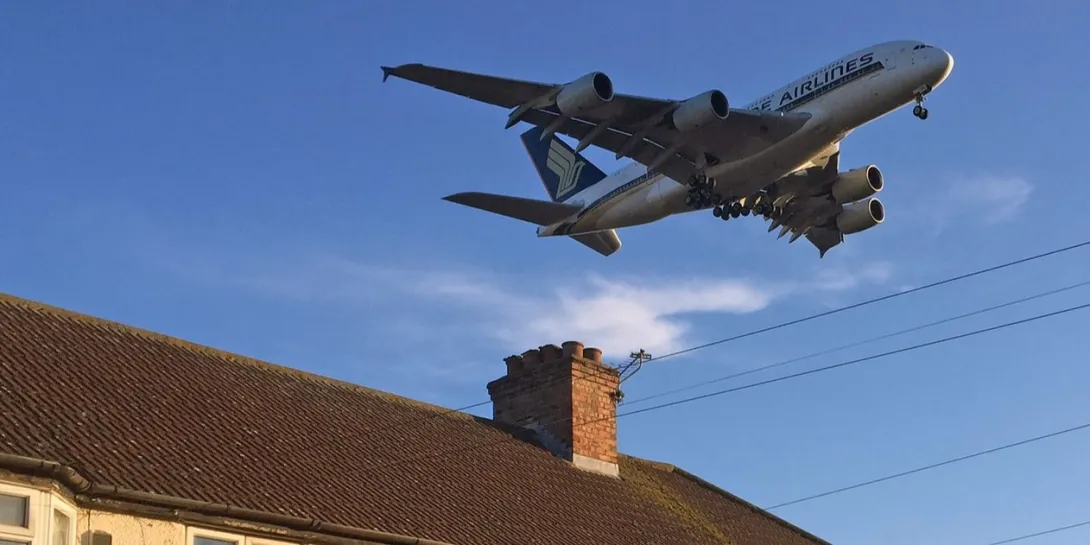
This consultation is an important stage in the decision-making process as to whether to build a third runway at Heathrow airport. The Heathrow Expansion National Policy Statement (HENPS) sets out the conditions under which plans for a third Heathrow runway could get approval.
Heathrow airport is already the single largest polluter in the UK. The new runway would be the equivalent of building a new airport the size of Gatwick next to Heathrow and the airport's own proposals would require thousands of homes to be destroyed and the M25 to be rerouted. The government's policy has been firmly in favour of airport expansion - not just at Heathrow, but approving expansion at Gatwick, Luton, and other airports around the country.
This reckless expansion is totally incompatible with the UK's legal commitment to reduce our overall emissions over time, reaching net zero by 2050. It ignores both the harms that climate breakdown is already causing, which will get much worse without climate action, and the risk of breaching dangerous climate 'tipping points'.
The most effective things you can do at this stage are:
1. Respond to the consultation, in your own words if you can, by emailing henpsconsultation@dft.gov.uk
If too many identical responses are submitted the government may treat them all as a single response from one campaign group
Below is a short template response and a longer consultation response which you can draw on for additional information (downloadable here). We have focused mainly on the climate arguments, and also on the economic case which is being used as justification for expansion. But there is a lot more information, for example on the impact on local residents, and you can find addition resources at the end of this page
2. Forward your response to your MP and say that as your constituent you are asking them to oppose a third Heathrow runway (don't forget to include your postal address). If you want to give them more information you could also forward them our longer response.
3. Share this call-out as widely as you can - by email, in WhatsApp groups, or on social media, using the links below.
Share on Facebook / Share on Bluesky / Share on X
This includes responses to some of the key questions. Use your own words where you can, particularly in the introduction.
I am writing to respond to the Draft Heathrow Expansion National Policy Statement: consultation on proposed amendments.
My name is _
My email address is _
I am very concerned about the proposed third runway, because the additional emissions from flights will endanger the UK's climate targets, particularly with many other UK airports already expanding. The UK should prioritise infrastructure to make us more resilient to climate change impacts, to cut emissions and to reduce our dependence on fossil fuels, not increasing emissions and worsening the climate crisis.
To what extent do you agree or disagree with the assessment of the need for the proposed expansion of Heathrow Airport? Explain your answer.
I strongly disagree that there is a need to expand Heathrow. The economic case for expansion is very weak. It is now only predicted to add 0.05% to GDP by 2056, and is likely to cause further regional inequality within the UK with jobs and economic activity being redistributed from other regions to London.
The DfT's own analysis shows negative impacts to far outweigh positive ones, giving the net present value of the scheme as between -£23.4bn and -£62.5bn.
A third runway is not compatible with the UK's legally binding climate commitments. It would bring aviation emissions up to almost double what they would be in the Climate Change Committee's 'balanced pathway' for reaching net zero. There is no credible plan for dealing with these emissions.
The government has proposed four tests which must be met for expansion to proceed. To what extent do you agree or disagree with how the government has set each of the ‘four tests’?
Air Quality
The impact of a third runway cannot be assessed using outdated air pollution limits. Currently the UK’s legal limit on NO2 is twice as high as the EU’s, and 4 times as high as the health based recommendations of the WHO.
Noise
Noise from flights overhead is be a serious problem affecting both mental and physical health in affected communities. The actual flight paths are not going to be published before the decision is made, so communities are being asked to respond without knowing exactly how they will be affected. However we do know that hundreds of thousands more people will be exposed to harmful noise with a third runway.
Climate change mitigation
The assessment of climate impact is seriously inadequate, in several ways.
It is overoptimistic about the consequences of increasing aviation emissions well beyond the limits recommended by the Climate Change Committee, assuming that other sectors of the economy will be able to somehow compensate or that new technological solutions will emerge. It underestimates the risk of increasing emissions in the short term as we near climate tipping points.
It does not take account of the warming impact of 'non-CO2 effects' including contrails, which are estimated to triple aviation's climate impact. It is not enough just to commission research and encourage efforts to reduce these, they should be properly included in the assessment of climate damage done by a third runway.
It assumes successful delivery of the government's Jet Zero strategy for reducing aviation emissions to net zero by 2050 while allowing aviation to expand. Currently there is no reason to believe that any of the measures within Jet Zero will achieve significant and genuine emissions reductions, let alone that the overall target can be met.
Jet Zero relies heavily on carbon offsetting, but research has shown that the vast majority of credits issued through offsetting schemes don't actually reduce emissions. There is no indication that engineering solutions to remove CO2 from the atmosphere can be massively scaled up, as would be required, and the technology is very expensive. Meanwhile there are very limited amounts of the sorts of waste oils, like used cooking oil, which are used to make biofuels for aircraft. There have been significant problems getting other types of alternative fuels produced at commercial scale, and questions about whether they are even sustainable.
The government should commit not to approve this scheme or any overall expansion in the UK's aviation capacity until there is strong evidence that the aviation industry is on track to achieve net zero emissions by 2050 as set out in Jet Zero.
Economic growth across the country
There is considerable evidence that Heathrow expansion will not lead to economic growth around the country, and in fact will have a negative effect outside London and the south east. Analysis by NEF (the New Economics Foundation) estimated that there would be 15,200 jobs lost in the wider regions of the UK and displaced to London and the south east.
In the cost benefit analysis, almost all the benefit is shown as being to passengers using the airport, rather than the wider community, and this benefit is vastly outweighed by the negative impacts, so the overall net present value of the scheme is calculated as between -£23.4bn and -£62.5bn.
To what extent do you agree or disagree with the proposed designation of Heathrow expansion as defined in the draft HENPS as Critical National Growth Infrastructure (CNGI)? Explain your answer.
Heathrow expansion should not be designated as Critical National Growth Infrastructure as this would seriously prejudice the decision making process. It would prevent proper examination of how weak the economic evidence is in favour.
I am also concerned that this designation could make the third runway impossible to challenge in the planning process, however much evidence is provided of high levels of harm to the climate and to local communities. As long as the developer planned to put in some effort to reduce these harms, it could be approved because it was already designated as 'critical infrastructure', despite the harms outweighing the benefits.
To what extent do you agree or disagree with the assessment of the need for the proposed expansion of Heathrow Airport? Explain your answer.
A third runway at Heathrow is not necessary and not compatible with the UK's climate obligations.
Current government policy on the climate impacts of airport expansion in the UK is inadequate because it does not consider the cumulative impact of allowing many airports to expand. Instead, every expansion scheme is allowed to proceed on the basis that, on its own, it will not prevent our climate targets from being met.
An even more serious problem is that decisions are taken assuming that 'Jet Zero' policies will lead to aviation having net zero emissions by 2050. As set out below, there is no evidence that more than a small fraction of emissions can actually be mitigated by these policies.
The decision on a Heathrow third runway may be presented as 'the economy versus the climate'. But this is misleading. Firstly, we know that failing to take climate action will lead to massive economic harm, which will dwarf the 0.05% GDP (maximum) that a Heathrow third runway is predicted to add to the UK economy by 2056. We have seen some of these this summer in widespread heatwaves and drought, but these impacts will get more severe every decade until net zero is reached globally.
Secondly, the evidence shows that a Heathrow third runway will not have significant economic benefit and will in fact be detrimental to regional economies outside London and the south east.
Thirdly, HENPS cites the 2015 Airports Commission which concluded that there was a need for a third Heathrow runway. However since the Airports Commission, extra capacity has already been approved at Gatwick, Luton, Stansted and London City airports. This makes the case for a third Heathrow even weaker, and it becomes much harder to justify either the harm which will be caused to the climate, or the health impacts and disruption to communities from building what is the equivalent to an airport the size of Gatwick next to Heathrow.
The government has proposed four tests which must be met for expansion to proceed. To what extent do you agree or disagree with how the government has set each of the ‘four tests’? Explain your answer for each test:
Air Quality
The impact of a third runway cannot be assessed using outdated air pollution limits. Currently the UK’s legal limit on NO2 is twice as high as the EU’s, and four times as high as the health based recommendations of the World Health Organization.
Noise
Noise from flights overhead is be a serious problem affecting both mental and physical health in affected communities. The actual flight paths are not going to be published before the decision is made, so communities are being asked to respond without knowing exactly how they will be affected. However we do know that hundreds of thousands more people will be exposed to harmful noise with a third runway.
Climate change mitigation
The scheme is not compatible with the UK's climate targets. In the “current trends” scenario, which captures all policy impacts currently in place, with Heathrow expansion, UK aviation emissions would reach 41Mt of CO2 by 2050.
The Climate Change Committee’s balanced pathway said that the 2050 Net Zero figure for aviation should be just over half of that amount: 21Mt per year
There is no credible plan for how greenhouse gas removals will scale from a tiny amount currently available to remove 41Mt of emissions from the atmosphere, let alone accounting for the non-CO2 warming effects of aviation on top of this.
The requirement in HENPS is that the applicant contribute to efforts to decarbonise aviation. This is not adequate to address the climate impact of a third runway, because there is no guarantee that these efforts will lead to significant emissions reduction overall.
Instead there should be a commitment not to approve this scheme or any overall expansion in the UK's aviation capacity until there is strong evidence that the aviation industry is on track to achieve net zero emissions by 2050 as set out in Jet Zero.
The basic requirements for this are:
Non-CO2 warming effects of aviation must also be fully included
Analysis of the climate impacts of expansion at Heathrow is misleading if non-CO2 impacts are not fully included in calculations. As explained in the Climate Change Committee's Seventh Carbon Budget, non-CO2 effects - the formation of clouds (contrails) and the emission of nitrogen oxides high up in the atmosphere - approximately triple aviation's climate impact when compared to CO2 emissions alone.
As the HENPS stands, non-CO2 impacts will not be included in calculating the climate impact of the scheme: "the applicant is not required to quantify the non-CO2 impacts of any scheme but should assess these impacts qualitatively." (section 5.67). Instead of excluding two-thirds of aviation's climate impact from decision-making, and therefore underestimating the overall harm, these non-CO2 warming effects must be quantified by giving a lower and upper estimate and included into consideration the climate impact of Heathrow expansion, and wider aviation policy.
Ignoring non-CO2 impacts also contributes to overestimating the effectiveness of measures such as carbon offsetting and using alternative fuels, which (in addition to the problems set out below) are only designed to address the carbon emissions. This means that up to two-thirds of aviation's climate impact unaccounted for.
The problems with Jet Zero
Currently there is no reason to believe that any of the measures within Jet Zero will achieve significant emissions reductions, let alone that the overall target can be met.
1. Carbon offsetting. Despite the focus on alternative fuels and technological measures, carbon offsetting is the main tool relied upon to achieve Jet Zero, including through the international aviation industry's CORSIA scheme. However, research has repeatedly shown that the vast majority of credits issued through such schemes are worthless.
A 2024 meta-review of 65 research studies, covering one-fifth of all carbon credits so far issued, concluded that less than 16% of the carbon credits issued constituted real emission reductions. [1] Fake carbon credits cannot counteract the climate impact of increasing flights.
It is also important to remember that the non-CO2 climate impacts of aviation are never offset at all, and these have an even greater impact on heating our atmosphere than the CO2 emitted from aircraft.
2. Engineered greenhouse gas removals. For example, HENPS suggests that building a third runway at Heathrow could be combined with investment in Direct Air Carbon Capture and Storage (DACCS) and Bioenergy with Carbon Capture and Storage (BECCS). Direct air carbon capture is very energy intensive, and therefore very expensive. Technical and financial problems have meant carbon capture in general has repeatedly underdelivered from what has been promised, and remains at a tiny scale. For example, the high-profile Climeworks DACCS operation in Iceland came under fire in 2025 for underperforming so badly that it appeared to be emitting more in the company's operations than it captured. [2] Finally, the idea that BECCS can be carbon-negative is based on the claim that burning wood for fuel is in itself carbon-neutral which has been comprehensively debunked.
3. Zero carbon aircraft. The weight of batteries means that electric aircraft are limited to small passenger numbers and relatively short flights, effectively being 'air taxis' rather than a replacement for general commercial flights. Commercial hydrogen-powered aircraft are a long way away: even minor aircraft redesigns take a long time, and these are wholly new designs which would need exhaustive safety testing. But more fundamentally, they would have to run on hydrogen generated from renewable energy. Again this is very expensive, in limited supply, and would be in high demand in a world transitioning to net zero.
4. Alternative fuels. The production of alternative fuels has been fraught with problems. Most production so far relies on a fuel source (waste oils and fats) which is is far too limited to meet more than a tiny fraction of global aviation fuel demand, especially considering competing demand from road transport and shipping.
A Reuters investigation found airlines have announced 165 'sustainable aviation fuel' (SAF) projects over the past 12 years. They found that of these, only 36 came to anything, of which just 10 have produced commercial volumes of fuel. [3] When interviewed, airline spokespeople have admitted their SAF ambitions are off track, blaming fuel companies for low supply of alternative fuels, while fuel companies blame airlines for insufficient demand at high prices.
Of the 36 projects that produced any SAF, all but one relied on the Hydroprocessed Esters and Fatty Acids (HEFA) process to convert waste oils, fats and grease into jet fuel. These waste oils are limited resources. So far almost all of the SAF used in the UK comes from imported used cooking oil, mostly from China. With increasing global competition for this resource, fraud is a concern. Exports of 'used cooking oil' from Malaysia are three times what is collected, suggesting that unsustainable palm oil are being used instead. [4]
An alternative to HEFA is converting waste products like wood and household waste to fuel through Fischer-Tropsch technology. British company Velocys has focused on this technology, but has also experienced problems taking production beyond pilot stage, narrowly avoiding insolvency in 2023.
More fundamental is the question of whether converting feedstock like household waste into aviation fuel can actually reduce emissions. During flight, all these alternative fuels produce the same CO2 emissions (and non-CO2 warming impacts) as conventional fuel. So their sustainability relies on carbon being removed from the atmosphere earlier in their lifecycle. This may not always be the case. Projects have been announced to convert sources such as old car tyres or styrofoam into aviation fuel. This may avoid pollution from alternative disposal methods, but in carbon terms it is still burning fossil fuel. Converting plastic into aviation fuel puts fossil carbon into the atmosphere just as burning conventional fuel does, plus the additional emissions from powering an extremely energy intensive conversion process.
One of the most commonly proposed fuel sources is household waste in black bags. Again, much of this is plastic, so to that extent is burning fossil carbon with no climate benefit over conventional fuel. Much of the rest of the waste could easily be recycled. Research by UKWIN has found that at least half of the contents of household black bags are recyclable, and also that waste incineration contracts discourage councils from increasing recycling rates. [5]
The final possibility is to use renewable energy to generate synthetic fuels, which is very expensive.
It is clear that alternative fuels cannot be relied on to make up more than a small percentage of carbon reductions towards net zero. They are not a 'game changer' in the words of the the former Chancellor, nor a good reason to ignore current climate impacts of airport expansion.
5. Efficiency improvements. Improvements in the efficiency of aircraft or engine design are welcome but can only be marginal
Economic growth across the country
There is considerable evidence that Heathrow expansion will not lead to economic growth around the country, and in fact will have a negative effect outside London and the south east. The government's cost-benefit analysis concludes that when environmental costs are priced in, the scheme has a negative net present value of between -£23.4bn and -£62.5bn over 60 years.
The predictions for eventual increase in UK GDP has now been decreased to 0.03-0.05%, just a tenth of that previously claimed.
NEF analysis of DfT data calculates that around two-thirds of the aviation-linked jobs created at Heathrow represent jobs displaced from other parts of the UK and that there would be 15,200 jobs lost in the wider regions of the UK and displaced to London and the south-east. [6]
Even within south east England the benefits are not evenly distributed. Almost all the benefits in the cost-benefit analysis are predicted to go to passengers using Heathrow. So the main beneficiaries are frequent flyers, who are wealthier than average. A pre-Covid survey indicated that 15% of the UK population accounted for 70% of flights. [7]
Expanding another London airport will also contribute to the tourism spending deficit across the UK outside London. In 2023, excluding London, UK residents spent £43bn more overseas than foreign residents spent in the UK, while London had a surplus of £1.3billion.
To what extent do you agree or disagree with the proposed designation of Heathrow expansion as defined in the draft HENPS as Critical National Growth Infrastructure (CNGI)? Explain your answer.
Heathrow expansion should not be designated as Critical National Growth Infrastructure.
It would seriously prejudice the decision making process to decide beforehand that the economic benefits claimed are of 'critical' importance to the UK, despite the fact that the evidence for them is weak. And to dismiss in advance the clearly-evidenced climate and community harms as less important - not 'critical'.
There is no evidence that expanding Heathrow airport is critical for national growth. In fact there is strong evidence against this claim.
The evidence provided suggests that a third runway at Heathrow would have a minimal overall impact adding (at maximum) 0.05% to GDP by 2056, and that it will most likely have a negative impact on the economy of regions outside London.
Finally, the UK economy faces a range of challenges in the coming decade. Some of these are hard to predict, but they will include preparing our infrastructure, food supply and society to face future climate shocks. In this difficult and uncertain future, it is hard to believe that adding yet more airport capacity in a capital city which is already one of the best connected in the world will be a critical limiting factor for our economy, even if it were possible to do so without further damaging the climate.
--
[1] Probst, B.S., Toetzke, M., Kontoleon, A. et al. Systematic assessment of the achieved emission reductions of carbon crediting projects. Nat Commun 15, 9562 (2024). https://doi.org/10.1038/s41467-024-53645-z
[2] https://reddmonitor.substack.com/p/climeworks-the-carbon-capture-company
[3] https://www.reuters.com/graphics/AVIATION-SUSTAINABILITY/movadylljpa/
[5] https://ukwin.org.uk/oppose-incineration/
[7] https://fullfact.org/economy/do-15-people-take-70-flights/
Draft Heathrow Expansion National Policy Statement
Heathrow Expansion Appraisal Report
Aviation Environment Forum webinar on the consultation
Losing Altitude - NEF report, p11-14 has information about how the aviation expansion is not an effective way of creating jobs and wages in the sector have been falling.
NGO statement on Labour's Heathrow Four Tests
AEF’s analysis of the performance of the draft HENPS against the NGO four tests briefing
E-action to submit a quick response to Heathrow consultation (Possible)