


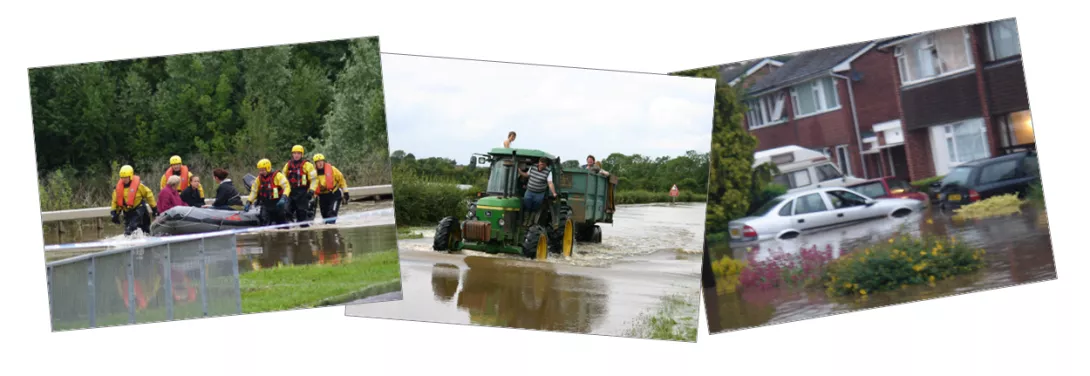
Far right agitators and tabloids claim that the UK is being flooded by refugees. This is not true. The floods affecting the UK in recent years are, in fact, far more literal. Climate breakdown is the real threat, not people choosing to make their home here.
Increased extremes of winter rainfall, storms and coastal erosion threaten our homes, infrastructure and agriculture, even while the risk of drought and heatwaves in the summer months also increases.
There is a simple rule that warm air can carry more water: for every 1C temperature rise, it can hold about 7% more moisture. This leads to more intense rainfall events, both here and around the world: we regularly see headlines of catastrophic flooding on every continent. Over time, UK winters have got milder and wetter, and it has been estimated that average rainfall on stormy days has become approximately 30% more intense due to global warming.
When we think of floods, we tend to think of rivers overflowing or perhaps coastal storms. However the most common flood risk nowadays in the UK is surface flooding, where rainfall is so heavy that drainage systems are overwhelmed.
Today 6.3 million houses in England are in areas at risk of flooding from rivers, the sea, and surface water. This is predicted to rise to around 8 million (a quarter of the total) by 2050.
Research has found that one in nine new homes in England between 2022 and 2024 were built in areas that could now be at risk of flooding.
Currently a scheme called Flood Re allows insurers to provide more affordable flood insurance to households at high risk, pooling the costs associated with higher-risk properties by paying a levy into a non-profit-making fund. All domestic policyholders help to subsidise the scheme at a cost of about £10.50 each annually. The scheme generally excludes properties built since 2009, a restriction intended to discourage further development in areas at risk of flooding. But the Flood Re scheme is a temporary fix that’s due to end in 2039, and the cost of flood damage is rising.
A recent study looked at costs not covered by insurance, for example having to move out of your house while it is repaired, to somewhere with a more expensive commute, further from your children's school, storage for belongings or replacing damaged items not covered by insurance. These hidden impacts are felt disproportionately by people living in social rented housing, for whom the costs can equal more than a month’s earnings.
It's estimated that over a third of the UK railway and road networks are currently at flood risk, predicted to rise to around half by 2050. Around 10% of UK hospitals are located in high flood-risk areas, and in England, a quarter of healthcare facilities are at risk of flooding, including emergency services, GP surgeries, and care homes.
It's not just about the financial cost: having your home flooded with filthy water can be traumatic. Communities hit by floods and storms can feel abandoned by central government with little support to recover from the crisis: in Cornwall where people were left without power, water and internet after Storm Goretti, in Devon where Storm Chandra flooded parts of the rail network as well as homes, and in Monmouth where record floods were largely overlooked by national media.
In England, unlike other UK nations, the fire service has no statutory duty to respond to flooding emergencies, leaving fire brigades under-resourced to deal with incidents, even while they are becoming more frequent. The FBU has repeatedly called for this statutory duty to be introduced to bring England in line with Scotland, Northern Ireland, and Wales.
England experienced its worst harvest on record in 2020, with a wet winter followed by an exceptionally dry spring. In 2024, heavy rain through winter hit key crops and made the harvest the second worst on record - until 2025 knocked it into third place with another poor harvest caused this time by drought. The persistent rain in parts of the UK this winter has affected farmers again. "Fields are under water and the roots of crops will be rotten." "The machinery just sinks and we simply can't get the crop out of the field."
Of course, much of our food is imported, so the impact of climate breakdown elsewhere affects food prices here. For example in February Storm Marta caused widespread floods and damage to farms in Spain and Morocco, the sources of a lot of fruit and vegetables in UK supermarkets, causing predictions of possible shortages.
Meanwhile another impact of climate breakdown is rising sea levels. Around the UK sea levels have risen by around 20cm since 1900 and this is accelerating - two thirds of the change so far has been in the last 30 years. This may not seem significant but even the sea level rise so far can make a big difference to the impact of storm surges.
Sea level rise also increases coastal erosion. Government data shows 3,500 properties (homes, businesses and schools) are in areas at risk of erosion in the next 30 years. If no action is taken, then 32,800 would be at risk by the end of the century. Repeated storm damage to the Dawlish coastal stretch of railway to Plymouth and Cornwall is an example of how our transport network is also vulnerable to climate change.
If we don't cut emissions, all these risks will increase - and not necessarily at a steady, manageable rate. It is striking that while Reform-led councils have cut climate policies and urge continued dependence on fossil fuels, these councils include some of the areas with the highest flood risk in the country.
As well as seeking to avert the worst impacts by cutting emissions, adaptation to what is already inevitable is essential - from simple steps like avoiding building new houses in areas of flood risk, to a much greater focus on landscape management in river catchments to absorb extreme rainfall. The Climate Change Committee reports that the government has not got an adequate plan to for the UK to adapt to the climate change we are experiencing today, let alone that coming in the future.
And we should note that the committee's own predictions focus on what is known, likely and expected during the coming decades. It doesn't cover impacts of climate tipping points like possible collapse of the Atlantic circulation bringing extreme winters to the UK, sea level rise over future centuries measured in metres not centimetres, or research suggesting sea levels may be rising 1cm a year by the end of this century. These possible extreme impacts show the need to cut emissions with all urgency even while sensible adaptation policies are adopted.
The one thing we cannot afford is climate denial. Communities at risk of flooding must join the call for urgent climate action.
Email info@campaigncc.org to request new flyers about flooding and climate change.
Friends of the Earth has an map of flood risk in England on which you can view current risk for your area, and how this might increase in future. You can also search for information from the relevant agencies for England, Scotland, Wales and Northern Ireland.
The Climate Coalition's Local Intelligence Hub lets you check, among other useful information, how many people are at risk of flooding in your constituency.
The Friends of the Earth report Is flooding in England getting worse has further information about risks and what needs to be done.
Photo credits: Flickr users Cheltenham Borough Council, Jon Whitton & shelly-jo