


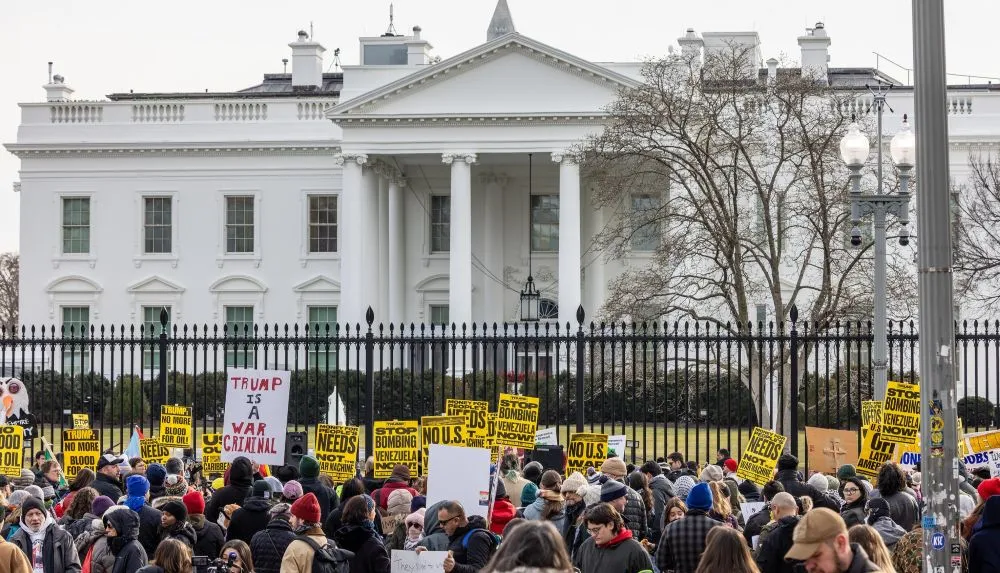
On 3 January 2026, Donald Trump announced on social media that the US had invaded Venezuela and kidnapped President Nicolás Maduro and his wife, without even seeking congressional approval and against international law.
Last month, implementing an oil blockade of Venezuela, Trump demanded in a typically unhinged social media post that Venezuela "return to the United States of America all of the Oil, Land, and other Assets that they previously stole from us."
The White House has announced the US intends to retain control of all sales of future oil production. Vice president JD Vance said, "We control the energy resources, and we tell the regime you’re allowed to sell the oil so long as you serve America’s national interest, you’re not allowed to sell it if you can’t serve America’s national interest."
Trump is also talking about more illegal military operations, threatening Colombia, Mexico, Cuba, and Greenland, and has announced the total withdrawal of the US from the UN climate process, along with 65 other international and UN bodies.
Less than two years previously, in a meeting with oil industry executives, Trump had demanded they raise $1bn for his White House re-election campaign and promised in return that if he was re-elected he would remove all climate regulations and environmental restrictions on pollution to boost their profits. The oil industry in turn wrote out executive orders ready for Trump to sign when he regained power.
Venezuela is sitting on oil reserves of over 300 billion barrels - more than any other country in the world, even Saudi Arabia, and three times as much as US reserves. Unlike Saudi Arabia or the US, however, this oil is mostly ultra-heavy crude oil, comparable only to Canada's tar sands. Because it is literally like tar, it needs to be melted with steam to be extracted and then diluted with lighter oil so it can be exported.
Despite these massive oil reserves, Venezuela's production levels have been relatively low in recent years. For two decades, from 1995 to 2015, Venezuela was producing around 3 million barrels a day, but this has dropped to less than one million, with the combined impact of US sanctions, mismanagement and a lack of investment in infrastructure maintenance. By comparison, under Obama, Trump and Biden, US oil production soared from around 7 million barrels to around 20 million barrels a day. (See this post and comments beneath).
In 2007, President Hugo Chávez implemented a policy that the national oil company Petróleos de Venezuela (PdVSA) should control a majority share in all operations in the country. Chevron renegotiated and stayed. ConocoPhillips and Exxon left and sought compensation for their expropriated assets through a World Bank arbitration panel that awarded them billions (not all paid). Between the cost of restoring infrastructure, oil companies funnelling profits out of the country and Venezuela's onerous debt burden, it is unlikely the people of Venezuela would see any of the proceeds from increasing oil production for the foreseeable future.
If Venezuelan production were to be ramped up again this would have dire consequences for the climate. Even extracting and processing the oil has a massive carbon footprint, because it is so energy intensive. The release of methane (a powerful greenhouse gas) is also far above the norm in Venezuela's oil and gas operations, with estimates showing upstream methane emissions roughly six times the world average. And that's even without the climate impact of burning this oil and the effect of increasing oil production further suppressing global prices and slowing the energy transition.
Analysis by Global Witness estimates that restoring production to previous high levels would lead to combined CO2 and methane emissions of 730 million tonnes of CO2 equivalent per year.
While Trump is demanding oil companies invest $100 billion in restoring Venezuela's largely dilapidated oil infrastructure, oil companies are openly expressing reluctance. But that doesn't mean they don't want to exploit Venezuela's oil, merely that they are negotiating for more favourable terms and may not commit to ramping up operations at the scale and speed he wants.
Increasing oil production also increases the danger of oil spills for Venezuela's people and ecosystems. Oil exploitation in the country has long gone hand in hand with environmental damage, and this will be exacerbated by a push to expand production with ageing pipelines and rusting infrastructure. The local ecosystem of plains crisscrossed by slow-moving rivers and wetlands is particularly vulnerable to oil spills. The pollution even extends to the US: for Black communities on the US Gulf coast where this oil will be processed, it means more pollution and health risks.
It's not just about Venezuela. In 2015, ExxonMobil announced that it had found a massive oil deposit off the coast of Guyana. This oil is not heavy crude so is much easier to extract and more profitable than Venezuelan oil. The region of Essequibo where this oil and other valuable resources such as gold and bauxite are found covers two-thirds of Guyana, and was part of pre-independence Venezuela, then disputed between Venezuela and Britain in the nineteenth century. The Maduro regime has been increasingly vocal about their desire to annex this region. In April 2024, Maduro signed a law declaring Essequibo a Venezuelan state. Then in 2025, Venezuela sent naval ships to threaten ExxonMobil oil production units operating in Guyana’s maritime territory. Trump's actions in Venezuela therefore also directly benefit Exxon and Chevron's operations in Guyana. Meanwhile, 58% of Guyana's population continue to live in poverty.
With their own reserves, plus effective control over operations in Venezuela and Guyana, the United States could control 30% of the world's oil reserves. While Trump's stated desire to annex Canada (with its own oil reserves) may have been dialled back, he is directly threatening other countries, saying a military operation targeting Colombia "sounds good" and repeatedly warning President Gustavo Petro to "watch his ass". He posted on Truth Social that trade between Cuba and Venezuela would be ended "I strongly suggest they make a deal, BEFORE IT IS TOO LATE."
And of course Trump is also eyeing up Greenland. “We are going to do something on Greenland, whether they like it or not. If we don’t do it the easy way, we’ll do it the hard way.” Greenland's resources include oil and gas reserves, but also minerals essentials for batteries, solar panels, electric vehicles and data centres - but which are incredibly difficult to get at ("You might as well mine the moon," said one expert)
The bottom line is that we know that building new oil and gas and infrastructure is not compatible with the (now increasingly out of reach) target of keeping global heating below 1.5C. Petrostate imperialism will drive us well beyond that. This is even more so if other governments are not willing to recognise the red lines for our climate in their domestic and foreign policy, are unwilling to clearly recognise breaches of international law and support the model of Global South resource exploitation for Global North profits.
Photos by Jason Gooljar of protestors gathering outside the White House on 3 Jan 2026