To support our campaign, and increase its scope, we need money. Please donate
Get your Union to support the Campaign. More info
Urgent online Actions - click here.
National Demonstration against Agrofuels,
Saturday 25th September

Stop subsidising Agrofuels and deforestation.
At the site of the proposed new palm-oil burning, agrofuel power station at Portland in Dorset.
Transport will be organised from London and possibly other places. If you are interested in joining the coach from London (to Portland for the day) please contact stopagrofuels@campaigncc.org or fill in the form below.
Provisional Timetable: 9.00 am: Bus leaves London for Portland
1.00 pm: Assemble for march
2.00 - 3.00 pm: Rally outside port gates (site of proposed plant)
3.00 pm: Workshops and entertainment in local hall
8.00 pm: bus sets off back to London.
Camping/crash will be available overnight.
If you are interested in travelling from London to Portland on a coach with other activists, please fill in the form below with your name and e-mail address and we will e-mail you as soon as we have confirmed coach arrangements. Any enquiries e-mail stopagrofuels@campaigncc.org.
The demonstration will be organised together with Biofuelwatch, Food not Fuel and a very strong local group, down in Dorset - NOPE (No Palm Oil Energy) see nope.org.uk
The application for an agrofuel power station in Portland was approved in January (after the initial rejection was overturned on appeal by the company making the proposal, W4B). The power station will burn palm oil and increase by one third the volume of palm oil currently being imported to this country for energy usage. See more here.
For an even bigger W4B plant proposed for Bristol, and how to help stop it, see next item, below. Stopping W4B in Portland will help to stop them in Bristol, too!
Agrofuel burning power stations like the one In Portland would not be going ahead were they not subsidised by the government. Insanely agrofuels are classified as a renewable energy and as such receive subsidies - so that, in effect, the government is subsidising massive deforestation in South East Asia (and other places), thereby accellerating, rather than slowing down, the destabilisation of global climate.
Make a stand against the madness of agrofuel use, wholesale destruction of the rainforest and spiralling emissions!
Download a flier to publicise the demo from our leaflets page.
Put the date in your diary now! More details soon.
1) Let councils take climate impacts into account: appeal to Eric Pickles and Chris Huhne
Please write to the Government today and ask them to confirm that it is not their intention to stop Councils from considering climate change and wider environmental and social impacts in planning applications for agrofuel power stations, as has been the case in the planning application for the Bristol power station (see below). To take part in the alert, please go to www.biofuelwatch.
2) Don't let them build a massive agrofuel power station in Bristol!
After Bristol City Council turned down W4B's application for a 50 MW mainly palm oil power station in February, the company is now appealing against the decision. Comments can still be submitted . See here for how to appeal to Bristol City Council: www.biofuelwatch.org.uk/w4bmay2010.php.
This will be a particularly important appeal. Not only would the one power station burn as much palm oil as is used altogether in transport biofuels, but what the company is challenging is a Council's right to consider climate change as well as other global impacts in such a planning decision.
DEMONSTRATION - 9:00-10:00AM, AUGUST 10TH
Bristol City Council, The Council House, College Green.
A coalition of local and national groups are opposing this appeal and wish to demonstrate the strength of local and national feelings against the proposed development when the appeal inquiry starts on 10th August. Download a .pdf flier here.
3) And help stop more agrofuel power stations in Leeds, Sheffield and Barnsley !
Rocpower is planning to build 6 new 'agro-fuelled' power stations in Yorkshire. You can write to object to the one in Barnsley here, Sheffield here or the one in Leeds here.
Agrofuels as "Biomass" for electricity generation: the looming threat
There is now a swelling stampede around the use biofuels for the purpose of generating heat and electricity in power stations .The use of biofuels as transport fuel (see below), in line with a disastrous EU policy (see here) has already drastically increased demand with all the terrible impacts on the environment and on rising emissions that that brings with it (see below) - but now this demand is set to rise yet higher as more and more applications are submiitted - and sometimes granted - for power stations using agrofuels.
In Germany and Italy, large amounts of electricity are being generated from burning vegetable oil already - and in nearly all cases palm oil is being used because this is the cheapest. It is the huge increase in demand for palm oil which is the biggest driver of deforestation in South East Asia, with huge consequences in terms of increased greenhouse gas emissions. There is every likelihood that this situation will be replicated in the UK : despite great quantities of greenwash that seek to project these new power stations as the cutting edge of environmental technology . None of the companies listed below has legally committed themselves not to burn palm oil - and in actual fact each one of them has explicitly mentioned palm oil in at least one planning application.
Here is a list of the power station applications which we know about (others may have gone unnoticed and agrofuels are increasingly used in small CHP plants and in heating boilers, for both of which no figure is available).
Blue NG (subsidiary of National Grid and 2OC):
19.5 Mega-Watts - Beckton, Newham, East London - approved summer 2008, not built yet. 18 MW - Southall, Ealing, West london - rejected September 2009, Appeal decision pending. Blue NG has spoken of plans for another 8-41 such power stations.
Thames Water
Not a power station but a desalination plant at Beckton, Newham which opened in Spring 2001 is to be run entirely on biodiesel, amounting to 20-35 MW if run at full capacity.
W4B Renewable Energy
50 MW - Bristol _ rejected by the council February 2010. Public Inquiry launched on Appeal.
18 MW - Portland - first rejected then approved by the council. Not built yet.
Vogen Energy
25 MW - Newport, South Wales - rejected by the council September 2009. Public Inquiry launched on appeal.
Rocpower (Hargreaves Services subsidiary):
7 MW - Leeds - decision pending.
8MW - Sheffield - decision pending.
7 MW - Barnsley - decision pending.
11MW - Wakefield - in operation.
Rocpower speaks of plans for 60 MW capacity overall in the North of England.
For a letter that was submitted to government by Biofuelwatch and many other organisations condemning the use of agrofules for elctricity generation and explaining why they are far from "green" as claimed.- see here.
For more about Agrofuel Power plants see here.
For a factsheet on the plans of Blue-NG - the company reponsible for the Beckton and Southall plans, see "Blue-NG: Opening up a new agrofuel market for power generation in the UK". For an analysis of their spin and conflicting messages see here.
Stop the government subsidising agrofuel use and deforestation!
There is a reason why we are facing a wave of new power stations using agrofuels. The government is classifying agrofuels as 'renewable' and subsidising their use to fuel these new power stations by awarding them ROCs - Renewable Obligation Certificates (see below the demonstration the campaign, together with Biofuelwatch, organised against ROCS for agrofuels last year). While the UK’s only significant wind turbine factory has just been closed up to twice as much subsidy is going to producing power from agrofuels than from onshore wind. Effectively - by subsidising agrofuels like palm oil - the government is subsiding deforestation and the huge emissions of greenhouse gases that that causes.
See the Friends of the Earth campaign against subsidising agrofuels here. See also their Biofuels: The Road to Nowhere campaign.
There was an EDM - EDM 230 - proposing a radical reform of EU bioenergy policy and a moratorium on awarding ROCS to power stations using agrofuels.
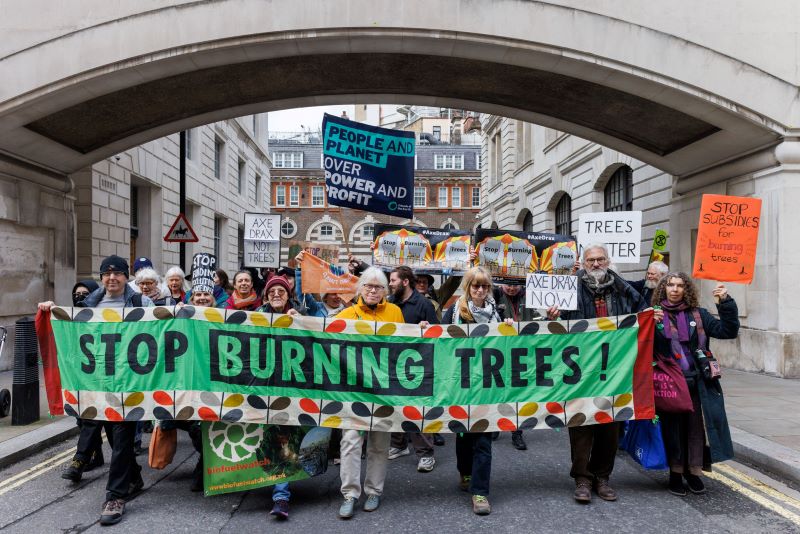
The Campaign against Climate Change joined Biofuelwatch and Food not Fuel to organise a protest against the subsidisation of agrofuels in October 2009 :

Maryla Hart speaking for 'Food not Fuel'
Demonstration against renewable energy subsidies for Agrofuels
Monday 12th October, 6.30 pm
At DECC (Dept of Energy and Climate Change), 3 Whitehall Place, London
Called by Campaign against Climate Change, Biofuelwatch and Food not Fuel
This was a lively demonstration with a great atmosphere! Good speeches from Kenneth Richter from Friends of the Earth, Rupert Read from the Green Party, Maryla Hart from ‘Food not Fuel’, Phil Thornhill from the ‘Campaign against Climate Change’, Amancay Colque from Coordinadora Latinoamericana. and also John Stewart from HACAN who chipped in with a few words about agrofuels as the 'long game' of the aviation industry. Also great music from, Pete, Mark et al!
Half way through there was a great moment when the Latin American contingent arrived on the last stop of their long day of actions in solidarity with indigenous people on this 'Day of Protecting Mother Earth'.
Photos from the evening are here. Earlier in the day there was a photo-op at the same place, the photos from the shoot are here. Videos are on a playlist on our YouTube channel.
For the demonstration organised by the CCC and Biofuelwatch against the use of biofuels in transport fuel in April 2008 see
.
AGROFUELS DRIVE DEFORESTATION DRIVES CLIMATE CHANGE
'Biofuels’ or ‘Agrofuels’ are fuels that are made from living plants (rather than the “fossilised” ones that make up oil and coal). The theory is that because these fuels absorb as much CO2 when they grow, as they emit when they are burnt, they are basically ‘carbon neutral’. Now, ‘biofuels’ made from waste materials like used chip fat are fine, but these could only ever supply a fraction of the demand if we use biofuels to replace any significant proportion of the transport fuel that now comes from fossil fuels. To do this requires growing crops for fuel (e.g. rapeseed, palm oil, soy, sugar cane or jatropha) on a massive scale (this is why we use the term “agrofuels”).
This increases the pressure on land and in places like Brazil, Uganda and Indonesia this increases the pressure on the rain forest and other surviving biodiverse ecosystems. Clearance for palm oil plantations is now the biggest driver behind deforestation in Indonesia and Malaysia and the rate of deforestation in the Amazon Basin has been shown to correlate directly with the price of soya which is set to continue on an upward trend because of agrofuel policies. Even if agrofuels are produced from, say, “certifiably sustainable” rapeseed in Europe this can have knock-on effects – it means there is less rapeseed available to produce cooking oils and foodstuffs and this results in a massively increased demand for Indonesian palm oil to fill the gap.
It is often overlooked that deforestation, and land use change, is the cause of about one quarter of total global CO2 emissions. Not only that but some rainforest ecosystems, are thought to be in danger of complete collapse. The Amazon for instance has been ‘drying out’ in recent years and if the process continued vast fires could take hold and precipitate a change to a different ‘dry forest’ or savannah state. This would release vast quantities of CO2 in a ‘positive feedback’ event that could constitute a ’tipping point’ where climate change escalated completely out of control. Deforestation is the biggest driver in this process – combined of course with higher temperatures from global warming, itself exacerbated by deforestation.
Not only that but using crops for fuels means there are less available for food – the huge demand of rich countries for fuel to drive their cars around is put in direct competition with the need of people in poorer countries just to eat. Within five years half ofthe US maize harvest is expected to be burned in cars, further pushing up the global proce of what is a staple food for hundreds of millions of people. Different studies show that a high percentage, possibly as high as 75% of the food price rises up to 2008 were due to agrofuels. Jean Ziegler, the former 'UN Special Rapporteur on the Right to Food' has called this a "crime against humanity". For more on the emerging global food crisis see here.
There have also been a catalogue of human rights abuses associated with the expansion of agrofuels. In Argentina 200,000 rural families have already been displaced and Victoria Tauli-Corpuz, Chair of the 'UN Permanent Forum on Indigenous Issues' has warned that 60 million indigenous people could become "agrofuel refugees". There have been a growing number of reports of the evictions of rural families and dispacement of food production for jatropha ( grown for fuel), especially.
Finally new ‘full cycle’ studies suggest that many biofuels actually cause more emissions than fossil fuel. This is greenhouse gas emissions directly associated with their production, not the devastating indirect, or long-term, effects referred to above. A recent study by Paul Crutzen suggests that the production of biofuel from rapeseed causes 70% more greenhouse gas emissions than those that would be caused by fossil fuels. This is mainly the nitrous oxide emissions from the fertiliser used to intensively farm rapeseed - something still overlooked by the EU.
So with all this damning evidence why are they going ahead with a massive expansion of agrofuels ? Well, in part at least, its because a new corporate alliance has evolved around the agrofuel boom - which includes oil companies, 'big business' and venture capitalists, car manufacturers and the biotech industry. (Car manufacturers back a "low carbon solution" that does not involve them in making drastic changes to their industry, while the biotech industry backs the genetic modification of crops to make them more suitable for biofuel production). This means there is a powerful self-interested lobby influencing all the decisions that are made.
The biggest loophole that this lobby exploits is so called "sustainability standards" which in practice are almost impossible to make effective. EU sustainability standards which will come into force in 2011 are deeply flawed to the point of being meaningless. Under EU rules, human rights abuses, pesticide poisoning and hunger cannot be used as reasons for ruling agrofuels 'unsustainable'. EU greenhouse gas calculations rely on false and creative accounting which contradicts scientific findings. And finally, companies can 'prove' compliance with standards simply by chosing and paying their own auditor - thats like using BAA's Environmental Impact Assessments as 'conclusive proof' that arirport expansion is good for the environment !
EU rules, however, do not prevent the UK government from meeting renewable energy targets without agrofuels but at the moment it shows no sign of doing this. The UK government continues to subsidise agrofuel power stations, oblige fuel suppliers to blend biofuels with all transport fuel and to suport the development of agrifuels for planes - thereby massively increasing the demand for agrofuels with all the destructive impacts we have described above.
For more information on the issues raised here see www.biofuelwatch.org.uk
See what Friends of the Earth has to say about biofuels here and read a report from Friends of the Earth Europe on agrofuels here.
PAST ACTIONS
organised by the Campaign agsint ClimateChaneg on Agrofuels
Protest against Brown on Biofuels
On Tuesday 15th April 2008 the CCC joined forces with Biofuelwatch to protest against the RTFO and the devestating impacts caused by a massive increase in biofuels. The protest, staged outside Downing Street at 6.00 pm, was the largest demonstration yet against biofuels and was widely reported on the day. Speakers at the demo included Ronnie Hall of the Global Forest Coalition, Kenneth Richter of Friends of the Earth, Pete Riley, campaign director of GM Freeze, Andrew Boswell of Biofuelwatch and Phil Thornhill of Campaign against Climate Change. Earlier in the day at 1.00 pm there was a very succesful photo-call and mini-demo outside the Department of Transport.
Photos from April 15th demos in London:
Lunchtime photo-op and mini-demo outside the Department of Transport, 1:00pm to 2:00 pm
Here we are with all our displays outside the Department of Transport at lunchtime on April 15th - and loads of press photographers have turned up.
More Photos here.
The main evening demo outside Downing Street, around 6:00pm to 7:30pm
All lined up along Whitehall opposite Downing street occupying the pavement and police 'pen' with our flags and banners on the barriers.
More Photos here.
There were also other demonstrations around the UK on April 15th at:
Aberdeen:
Aberdeen Campaign against Climate Change held a banner protest outside BP. They also held a demo outside Royal Bank of Scotland, Union Street who are financing the Ensus biofuel refinery and another in Ireland.
Brighton
Brighton biofuel activists made a colourful banner and flyer tour of Brighton city centre and Sussex University on Tuesday, talking to people taking all forms of public transport and dropping windscreen alerts to raise awareness around the new RTFO. For more photos and a press release, see: http://www.indymedia.org.uk/en/2008/04/396734.html .
Bristol
Members of Bristol Rising Tide and Espacio Bristol –Colombia held a protest outside a Tesco petrol station in Eastville, Bristol from to highlight the devastating consequences that agrofuels from monocultures will have on the climate, ecosystems, food prices and human rights. Tesco are a major investor in agrofuels and have been a biofuel market leader amongst UK supermarkets.
Cirencester
Traffic Lights for Peace leafleted the petrol station at Tesco's in Cirencester on April 15th to highlight the instigation of the RTFO.
Cheltenham
Cheltenham Friends of the Earth organised and attended a peaceful banner protest at Tescos, which was supported by Campaign Against Climate Change Gloucester and Stroud Green Party. Within minutes security had removed protestors from the premises. Despite the foul weather over a 150 leaflets were distributed to passing motorists and were very well received.
Edinburgh
An anonymous group of agrofuel activists disabled several pumps at two BP filling stations. BP was targeted as a major investor in agrofuels.
Separately, and later in the day, some 25 people held a lawful banner protest outside the BP petrol station in Bruntsfield, Edinburgh. The protest was organised by Agrofuel Action Edinburgh. People dressed as trees formed a “forest” and handed out leaflets about the damaging effects of agrofuels and BP's involvement. Edinburgh Rebel Clown Army members then “deforested” them and the “trees” started to emit black CO2 balloons. Others “greenwashed” the BP sign with green water and a mop. The spectacle was accompanied by a strong police and media presence. Unfortunately, 5 clowns who had created a fun, party-like, light-hearted atmosphere at the protest were suddenly surrounded by police and arrested. They were charged with Breach of the Peace for ‘milling around’. Read more about the arrests here ... and here ... and here ... and here and here for a slide show.
Ghent (BELGIUM)
Thirty activist of "agrocrisis" blocked the gates of the Cargill factory in Ghent (Belgium). Several activist are chained to the main gate blocking entrance to trucks.
Glasgow
Protesters against biofuels dropped a banner at Charing Cross today, to draw attention to the use of food to make petrol. See Indymedia report
There was also a protest at the BP station near Anniesland in Glasgow on 19th April. Banners were hung and leaflets handed out to motorists for an hour and a half.
Gloucester
On April 15th to draw attention to the Renwable Transport Fuel Obligation, Campaign against Climate Change Gloucester targeted shoppers at Tesco's largest Gloucester store, at St. Oswald's site.
Hitchin
About 12 people from Hitchin and Lethworth held a protest on 12th April, calling on the UK government to drop the RTFO.
Leeds
Huddersfield Friends of the Earth organised a banner protest with leafleting outside the constituency office of Hilary Benn, Secretary of State for the Environment.
Manchester/Bolton
Campaigners from Manchester held a banner protest with costumes, samba music and an orang-utan costume outside the constituency office of Ruth Kelley, Secretary of State for Transport, the minister directly responsible for the RTFO.
Stroud
On April 15th Traffic Lights for Peace protested at the main Tesco in Stroud at the government's introduction of the RTFO and Tesco's position as market leader at the forecourt. Many customers were bemused by the Government's apparent lack of thought into the issue, especially in view of majority world food shortages.
See pictures and more details & links here.
Photos from Biofuelwatch demo, Wednesday 30th January, 12.30 - 2.30 pm, outside the Greenergy office at 198 High Holborn, London.
The banner that says it all, outside the offices of Greenergy a company involved in biofuels made from raw products including palm oil and soy.
More photos from the demo here.
For more pictures from the Biofuelwatch week of actions around the country see here.
'Biofuels’ or ‘Agrofuels’ are fuels that are made from living plants (rather than the “fossilised” ones that make up oil and coal). The theory is that ...
Read more about biofuels and climate change
Top Floor, 5 Caledonian Road, London, N1 9DX, UK | Phone: +44(0)207 833 9311 | Mob: +44(0)790 331 6331 | info@campaigncc.org